Plane Transformations
A plane transformation maps each point P(x,y) to an image P′(x′,y′). Further Mathematics problems require both geometric descriptions and analytic or matrix representations.
1. Translation
A translation by vector (a,b) maps
(x,y) ↦ (x+a, y+b).
It preserves lengths, angles, orientation and parallelism. In homogeneous coordinates it may be represented by a 3×3 matrix, although ordinary 2×2 matrices alone do not encode a non-zero translation.
2. Rotation about the origin
An anticlockwise rotation through angle θ has matrix
R(θ) = [ cosθ −sinθ ; sinθ cosθ ].
For a rotation about C(a,b), first translate C to the origin, rotate, then translate back:
P′ = C + R(θ)(P−C).
3. Reflection
Reflection in the x-axis maps (x,y) to (x,−y); reflection in the y-axis maps (x,y) to (−x,y); reflection in y=x maps (x,y) to (y,x). Reflection in a general line may be handled by translating and rotating the line onto an axis, reflecting, then reversing the preliminary transformations.
4. Enlargement
An enlargement with centre C and scale factor k satisfies
P′ = C + k(P−C).
When k is negative, the image lies on the opposite side of the centre. Areas are multiplied by k².
5. Composition
The notation T₂∘T₁ means apply T₁ first and then T₂. Matrix multiplication follows the same order: if T₁ has matrix A and T₂ has matrix B, the composite has matrix BA.
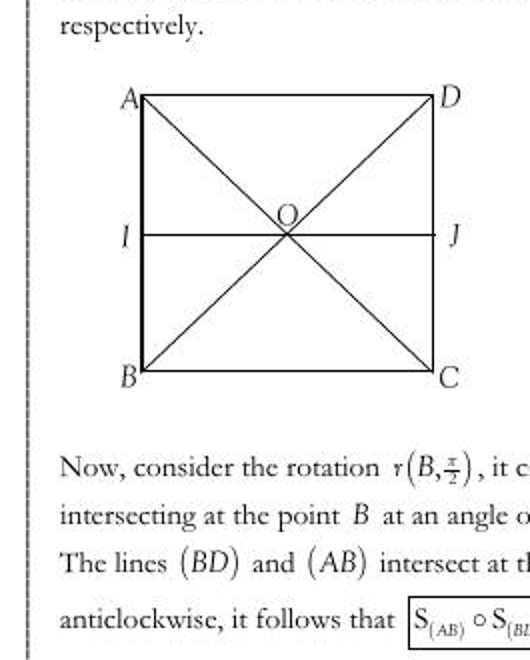
Two reflections in parallel lines produce a translation perpendicular to the lines.
Two reflections in intersecting lines produce a rotation about their point of intersection through twice the directed angle between the lines.
6. Glide reflection
A glide reflection is a reflection in a line followed by a translation parallel to that line. It reverses orientation but has no fixed point unless the translation is zero.
7. Invariants and fixed points
An invariant point is unchanged by the transformation. A rotation has its centre as a fixed point, a reflection fixes every point on its mirror line, and a non-zero translation has no fixed point. An invariant line may map onto itself even if its individual points move.
Worked example
Reflect a point first in y=0 and then in y=x. The first reflection maps (x,y) to (x,−y). The second swaps the coordinates, giving (−y,x). This is exactly an anticlockwise rotation through 90° about the origin.
Matrix example
The matrix A=[0 −1; 1 0] maps (1,0) to (0,1) and (0,1) to (−1,0), so it represents a 90° anticlockwise rotation. Since A⁴=I, four applications return every point to its original position.
Practice questions
- Find the image of (4,−2) under a rotation of 60° anticlockwise about the origin.
- Determine the matrix of reflection in the line y=−x.
- Show that two reflections in parallel lines separated by distance d produce a translation of magnitude 2d.
- Find the fixed point of the transformation x′=−y+3, y′=x−1.
- Describe geometrically the composite of reflections in two lines meeting at 35°.