Alcohols (Alkanols)
The alcohols form a homologous series with the hydroxyl group (−OH) as the functional group. Aliphatic alcohols have the general molecular formula CnH2n+1OH, where n is a whole number that can take values such as 1, 2, 3…
Nomenclature of Alcohols
Alcohols are named according to IUPAC rules. The root is derived from the longest carbon chain that must contain the carbon to which the hydroxyl group is attached. This carbon chain is numbered such that the carbon atom bearing the hydroxyl group takes the smallest possible number. The name begins with prefixes, if any, and ends with the suffix –ol.
The first five members of this homologous series are:
| Alcohol | Molecular Formula | Structural Formula |
|---|---|---|
| Methanol | CH₃OH | CH₃–OH |
| Ethanol | C₂H₅OH | CH₃CH₂–OH |
| Propan-1-ol | C₃H₇OH | CH₃CH₂CH₂–OH |
| Butan-1-ol | C₄H₉OH | CH₃CH₂CH₂CH₂–OH |
| Pentan-1-ol | C₅H₁₁OH | CH₃CH₂CH₂CH₂CH₂–OH |
Ethanol
Ethanol is the most important alcohol and is by far the best known.
Preparation of Ethanol
- Hydration of ethene: Ethene, obtained by the cracking of heavy petroleum products, can be hydrated to form ethanol. There are two ways of doing this:
- By absorbing ethene in concentrated sulphuric acid at 80℃ and 30atm pressure, to form ethylhydrogen sulphate.
CH₂=CH₂(g) + H₂SO₄(aq) → C₂H₅HSO₄(aq)(ethylhydrogen sulphate)
The ethylhydrogen sulphate is then hydrolysed with boiling water to form ethanol.
C₂H₅HSO₄(aq)(ethylhydrogen sulphate) + H₂O(l) → C₂H₅OH + H₂SO₄(aq)
- By passing ethene and steam over a catalyst of phosphoric acid, at a temperature of 300℃ and a pressure of 65atm.
CH₂=CH₂(g) + H₂O(g) →H₃PO₄, 300℃, 65atm C₂H₅OH(g)
- By absorbing ethene in concentrated sulphuric acid at 80℃ and 30atm pressure, to form ethylhydrogen sulphate.
- Fermentation of sugar or starch: Fermentation is the biochemical process by which sugar or starch is converted to ethanol and carbon dioxide.
To manufacture ethanol from a starchy foodstuff such as potatoes, rice, wheat, barley etc., the following steps are taken:
- The starchy foodstuff is crushed and cooked under pressure to release starch grains.
- Malt (partially germinated barley) is added to the mixture, which is then maintained at a temperature of about 60℃ for one hour. The malt supplies an enzyme (an organic catalyst) called diastase, which catalyses the hydrolysis of starch to maltose.
2(C₆H₁₀O₅)n(s)(starch) + nH₂O(l) →diastase, 60℃ nC₁₂H₂₂O₁₁(maltose) (catalytic hydrolysis)
- Yeast is then added at room temperature, which supplies two enzymes namely maltase and zymase. Maltase catalyses the hydrolysis of maltose to glucose.
C₁₂H₂₂O₁₁(maltose) + H₂O(l) →maltase, 27℃ 2C₆H₁₂O₆(glucose) (catalytic hydrolysis)
- Zymase catalyses the fermentation of the glucose to ethanol and carbon dioxide. This fermentation process may take place for two days.
C₆H₁₂O₆(glucose) →zymase, 27℃ C₂H₅OH(ethanol) + CO₂(g) (fermentation)
- The solution obtained after fermentation contains only about 10 to 15% ethanol. Higher concentrations of ethanol cannot be obtained by fermentation because the yeast cells will be killed by the high ethanol content.
- However, high concentrations of ethanol are usually obtained by fractional distillation. This also purifies the ethanol. The products of fractional distillation are called spirits, e.g. rectified spirit, which is the ethanol generally sold, contains 95% ethanol. Methylated spirit contains about 85% ethanol.
Physical Properties of Ethanol
- It is a colourless, volatile liquid.
- It has a characteristic taste and smell.
- It is neutral to litmus.
- It is a non-electrolyte.
- Ethanol is soluble in water in all proportions. This is because it can easily form hydrogen bonds with water molecules using the –OH group.
- It has a boiling point of 78℃.
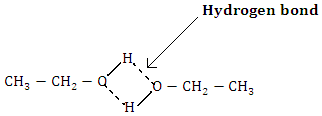
Remark: Generally, the boiling points of alcohols are higher than those of corresponding alkanes because molecules of alcohols form hydrogen bonds with each other while molecules of alkanes do not.
Uses of Ethanol
- Ethanol is an important solvent in varnishes, polishes, perfumes, drugs, dyes and stains.
- It is a raw material used in the manufacture of many important compounds like ethanoic acid, esters etc.
- It is used in hospitals for sterilizing medical equipment.
- It is an ingredient in alcoholic beverages such as beers, wines, whisky etc.
- It is used as a fuel by itself or mixed with petrol to form gasohol.
Chemical Properties of Alcohols
- Reactions of the hydroxyl group
- Reactions with sodium and potassium: If a small piece of metallic sodium is added to ethanol at room temperature, effervescence will occur with the liberation of hydrogen gas. An ionic sodium salt called sodium ethoxide is also formed.
2C₂H₅OH(l) + 2Na(s) → 2C₂H₅ONa(sodium ethoxide) + H₂(g)
By evaporating the solution to dryness, the sodium ethoxide is obtained as a white deliquescent solid. Solid sodium ethoxide is rapidly hydrolysed by cold water to form an alkaline solution.
C₂H₅ONa(s) + H₂O(l) → C₂H₅OH(l) + NaOH(aq)
Metallic potassium also reacts with ethanol in the same manner to form potassium ethoxide.
- Reaction with phosphorus(V) chloride: Phosphorus(V) chloride (or phosphorus pentachloride) reacts vigorously with an alcohol in a cold mixture, liberating steamy fumes of hydrogen chloride. Phosphorus(V) chloride reacts with ethanol as follows:
C₂H₅OH(l) + PCl₅(l) → C₂H₅Cl(ethyl chloride) + POCl₃(l) + HCl(g)
The reaction between an alcohol and phosphorus(V) chloride can be used as a test for the –OH radical in an organic compound.
- Reactions with sodium and potassium: If a small piece of metallic sodium is added to ethanol at room temperature, effervescence will occur with the liberation of hydrogen gas. An ionic sodium salt called sodium ethoxide is also formed.
- Oxidation: Ethanol can be oxidized by inorganic oxidizing agents, such as acidified potassium dichromate, to ethanal and ethanoic acid. When ethanol is warmed with acidified potassium dichromate, it is first oxidized to ethanal (which is given off as a pungent irritating vapour). The colour of the solution changes from orange to green, as the potassium dichromate is reduced.
C₂H₅OH(l) →H⁺/Cr₂O₂₂⁻₄∑, [O] CH₃CHO(ethanal) + H₂O(l)
Further oxidation of the ethanal by more acidified potassium dichromate gives ethanoic acid.
CH₃CHO(ethanal) →H⁺/Cr₂O₂₂⁻₄∑, [O] CH₃COOH(ethanoic acid)
Remark: Wine becomes sour on prolonged exposure to the atmosphere due to bacterial oxidation of the ethanol in the wine to ethanoic acid.
- Dehydration: In the presence of excess conc. H₂SO₄ at a temperature of 180℃, ethanol reacts to form ethyl hydrogensulphate, which decomposes to ethene and sulphuric acid.
C₂H₅OH + H₂SO₄(aq) → C₂H₅HSO₄(aq)(ethylhydrogen sulphate) + H₂O(l)
C₂H₅HSO₄(aq)(ethylhydrogen sulphate) →180℃ C₂H₄ + H₂SO₄(aq)
Overall reaction:
C₂H₅OH →excess conc. H₂SO₄, 180℃ C₂H₄ + H₂O(l)
Remark: If after the formation of ethylhydrogen sulphate, ethanol is present in excess and the temperature is lowered to 140℃, they will react to form ethoxyethane instead.
C₂H₅HSO₄(aq) + C₂H₅OH →140℃ C₂H₅OC₂H₅(ethoxyethane) + H₂SO₄(aq)
- Combustion: In excess oxygen, ethanol burns with a pale blue flame to form carbon dioxide gas and water vapour.
C₂H₅OH + 3O₂(g) → H₂O(g) + 2CO₂(g)
- Esterification: This is the reaction between an alcohol and a carboxylic acid to form an ester and water in the presence of concentrated sulphuric acid, which acts as a catalyst, i.e.
Alcohol + Carboxylic acid ⇄conc. H₂SO₄ Ester + Water
Ethanol and ethanoic acid undergo esterification in the presence of concentrated sulphuric acid to form ethyl ethanoate and water. The ester produced is recognized from its sweet, pleasant smell and oily nature.
C₂H₅OH(l)(ethanol) + CH₃COOH(ethanoic acid) ⇄conc. H₂SO₄ CH₃COOCH₂CH₃(ethyl ethanoate) + H₂O
The reaction is reversible, and the backward reaction (i.e. the reaction between the ester and water to give an alcohol and an organic acid) is called ester hydrolysis.
Tests for Alcohols
- The unknown substance is mixed with a carboxylic acid and a few drops of concentrated sulphuric acid are added. The mixture is heated gently for one to two minutes. If a vapour that has a fruity and pleasant sweet smell is evolved, then the unknown substance is an alcohol.
- The unknown substance is reacted with phosphorus pentachloride; if steamy white fumes of hydrogen chloride are produced, then the substance may be an alcohol.
Remark: Both carboxylic acids and alcohols produce steamy white fumes of hydrogen chloride when reacted with phosphorus pentachloride; hence this reaction cannot be used to distinguish between them.
Distinctive Tests Between Alcohols and Carboxylic Acids
- Carboxylic acids react with sodium carbonate to produce a colourless, odourless gas (carbon dioxide) which turns lime water milky, whereas alcohols produce no effect with sodium carbonate.
- Carboxylic acids turn blue litmus red while alcohols have no effect on litmus.