Cellular exchanges
Cellular exchange is the movement of substances into and out of a cell. Substances cross the cell surface membrane by diffusion, osmosis, active transport, or facilitated diffusion.
The animal cell and its membrane
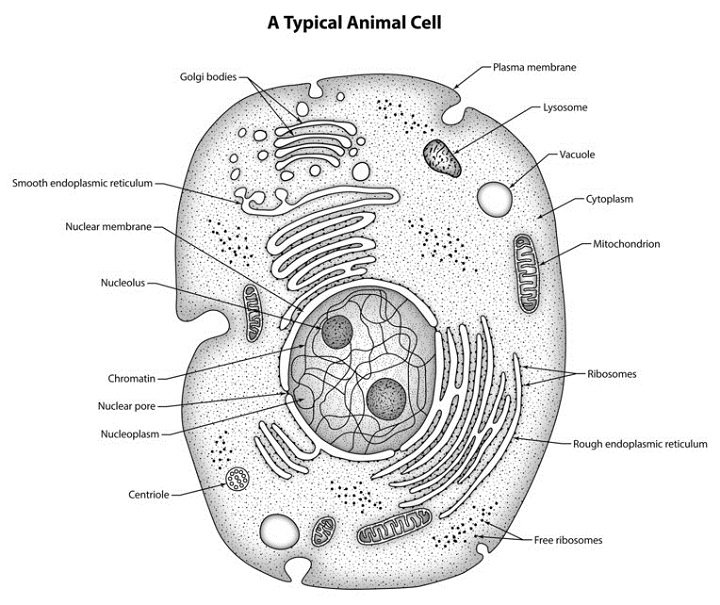
The cell surface membrane is selectively permeable. It allows some substances to pass through more easily than others, helping the cell to maintain suitable internal conditions. The membrane is supported by the cytoplasm and contains the cell organelles that carry out specialised functions.
Solutions and concentration
A solute is a substance that dissolves in a solvent. A solvent is the liquid that dissolves the solute. A solution is the uniform mixture formed when a solute dissolves in a solvent. A concentration gradient is a difference in concentration between two regions.
- Hypotonic solution: a solution with a lower solute concentration.
- Hypertonic solution: a solution with a higher solute concentration.
- Isotonic solutions: solutions with equal concentrations.
Diffusion
Diffusion is the net movement of particles from a region of higher concentration to a region of lower concentration until the particles are more evenly distributed. Diffusion does not require energy from respiration.
For example, when a drop of ink is added to water, ink particles spread from the region where they are concentrated until the water becomes more uniformly coloured.
Factors affecting the rate of diffusion
- The difference in concentration between the two regions.
- The temperature of the surrounding medium.
- The size of the diffusing particles.
- The surface area across which diffusion takes place.
- The distance over which the particles must move.
Importance of diffusion
Diffusion is important in the exchange of oxygen and carbon dioxide at respiratory surfaces. It also enables digested substances to move from the small intestine into the blood and allows waste gases such as carbon dioxide to leave cells.
Osmosis
Osmosis is the net movement of water molecules from a region of higher water potential to a region of lower water potential through a selectively permeable membrane. Only water molecules move through the membrane in this definition.
In an investigation using a living potato tissue, a sugar solution is placed in a cavity in the potato. Water enters the cavity through the living tissue, causing the level of the solution to rise. A boiled potato does not produce the same result because boiling destroys the living cell membranes needed for osmosis.
Effects related to osmosis
- Plasmolysis: loss of water causes the cytoplasm of a plant cell to pull away from the cell wall.
- Turgidity: water enters a plant cell, making it firm against the cell wall.
- Crenation: an animal cell shrinks after losing water in a concentrated solution.
- Haemolysis: an animal cell may swell and burst when too much water enters it.
Active transport
Active transport is the movement of substances from a region of lower concentration to a region of higher concentration through a selectively permeable membrane, using energy released by respiration. It requires living cells and membrane proteins.
Examples include the uptake of mineral ions by plant root hairs, the absorption of glucose in the small intestine, and the selective reabsorption of useful substances in kidney tubules.
Facilitated diffusion
Facilitated diffusion is the movement of substances down a concentration gradient through specific carrier or channel proteins in the cell surface membrane. It does not require energy from respiration, but it depends on membrane proteins.
Comparison of transport processes
| Process | Direction of movement | Membrane needed? | Energy needed? |
|---|---|---|---|
| Diffusion | Higher concentration to lower concentration | Not always | No |
| Osmosis | Higher water potential to lower water potential | Yes, selectively permeable | No |
| Active transport | Lower concentration to higher concentration | Yes | Yes |
| Facilitated diffusion | Higher concentration to lower concentration | Yes, with transport proteins | No |
Summary
- Diffusion and facilitated diffusion move substances down a concentration gradient without using cellular energy.
- Osmosis is the movement of water through a selectively permeable membrane.
- Active transport moves substances against a concentration gradient and uses energy.
- The cell surface membrane controls exchange between the cell and its surroundings.
Revision questions
- Define diffusion and state two factors that affect its rate.
- Distinguish between a solute, a solvent, and a solution.
- Explain why osmosis occurs in living potato tissue but not in boiled potato tissue.
- Compare diffusion and active transport in terms of direction and energy requirement.
- State one difference between facilitated diffusion and active transport.