Meaning of electrochemistry
Electrochemistry studies the relationship between electrical energy and chemical change. Electrolysis is the decomposition of a molten compound or solution by an electric current.
Electrolytes and electrodes
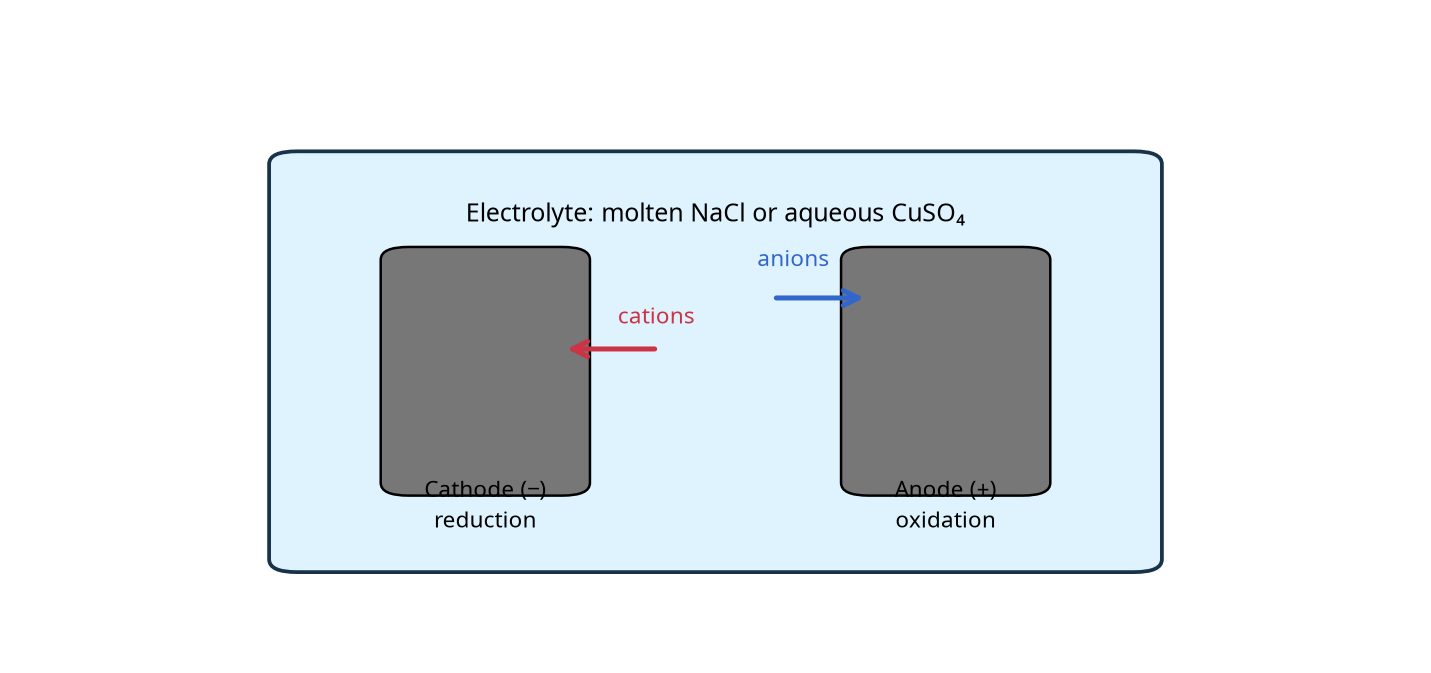
Strong electrolytes ionise almost completely, weak electrolytes partially, and non-electrolytes do not produce mobile ions. In an electrolytic cell the cathode is negative and is the site of reduction; the anode is positive and is the site of oxidation.
Molten sodium chloride
At the cathode: Na⁺ + e⁻ → Na. At the anode: 2Cl⁻ → Cl₂ + 2e⁻. Overall: 2NaCl(l) → 2Na(l) + Cl₂(g).
Aqueous electrolysis
In aqueous solutions, preferential discharge depends on the electrochemical series, concentration and electrode type. In concentrated brine, hydrogen forms at the cathode, chlorine at the anode and sodium hydroxide remains in solution.
Copper(II) sulfate and electrorefining
With inert electrodes, Cu²⁺ + 2e⁻ → Cu at the cathode and 4OH⁻ → O₂ + 2H₂O + 4e⁻ at the anode. With copper electrodes, copper dissolves at the anode and deposits at the cathode.
Quantitative electrolysis
Use Q = It, where Q is charge, I current and t time. One Faraday is approximately 96,500 C mol⁻¹ for singly charged ions. Applications include electroplating, copper purification and extraction of sodium and aluminium.