Extraction, Properties and Uses of Metals
Metals are extracted from naturally occurring mineral deposits called ores. The three principal steps in the extraction of a metal from its ore are:
- Purification and concentration of the ore: The main impurities present in metal ores are earthy materials such as rocks, clays and sand. When these impurities are removed from the metal ore, it becomes concentrated. One useful method of removing earthy impurities from metal ores is froth flotation.
- Reduction of the purified ore to the metal: There are several methods of reducing metal ores to the various metals. The method used depends mainly on the position of the metal on the reactivity series.
- Purification of the metal: The metal obtained by the reduction of the ore is usually contaminated with impurities. The crude or impure metal is then purified or refined.
Factors Influencing the Choice of Method Used to Extract a Metal
- The position of the metal on the reactivity series, which is directly related to the ease with which the ore can be reduced to the metal.
- The economic cost of the process.
- The ease with which the ore can be purified.
Methods of Extraction of Metals in Relation to the Reactivity Series
| Metal | Reactivity | Method of Extraction |
|---|---|---|
| K, Na, Ca, Mg, Al | Very reactive metals | Electrolysis: electrolytic reduction of their molten or fused ores (usually chlorides) occurs as the metal ions gain electrons and are deposited as pure metallic atoms at the cathode. |
| Zn, Fe, Sn, Pb | Moderately reactive metals | Chemical reduction of the purified ores by suitable reducing agents such as: coke (a form of carbon), used in the extraction of lead; carbon monoxide, used in the extraction of iron; sodium or magnesium, used in the extraction of titanium. |
| Cu | Less reactive metal | Thermal reduction by roasting the ore in air. |
| Ag, Au | Unreactive metals | Mining of the metals in the native form, i.e. uncombined with other elements. |
The Extraction of Iron
Iron is the second most abundant element after aluminium. It can be extracted from the following ores:
- Haematite (Fe₂O₃) → iron(III) oxide
- Magnetite (Fe₃O₄) → triiron tetraoxide
- Iron pyrite (FeS₂)
The principal or chief ore from which iron is extracted is haematite. The ore is first roasted in air to remove water and volatile impurities and convert any iron(II) oxide to iron(III) oxide.
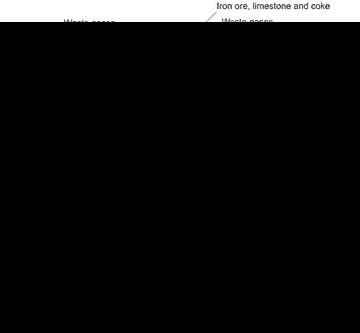
The roasted ore, which contains silica or sand (silicon dioxide) as the main impurity, is mixed with coke (a form of carbon) and limestone (a form of calcium carbonate). The mixture is introduced into the blast furnace from the top.
The blast furnace is a steel tower with an inner lining of fire of refractory (heat-resistant) bricks. It is about 30–40 metres tall and 8 metres wide.
- A blast of hot air is forced up the furnace from the bottom through pipes called tuyeres, hence the name blast furnace. The temperature of the furnace decreases from about 2000℃ at the bottom to about 400℃ at the top.
- The oxygen in the hot air reacts with coke in a highly exothermic reaction forming carbon dioxide.
C(s) + O₂(g) → CO₂(g) + heat
The heat released maintains the bottom part of the furnace at the required temperature of about 2000℃.
- As the carbon dioxide formed rises up the furnace, it comes into contact with more coke and is reduced to carbon monoxide.
CO₂(g) + C(s) → 2CO(g)
- At about 600℃, the carbon monoxide reduces the iron(III) oxide in the iron ore to metallic iron.
Fe₂O₃(s) + 3CO(g) → 2Fe(s) + 3CO₂(g)
- The solid iron formed descends towards the bottom of the furnace (which is hotter) and eventually melts. The molten iron is tapped off at intervals.
- The limestone in the furnace plays an essential function by removing silica or sand, the main impurity in the ore. The limestone decomposes at a temperature of about 1000℃ to quicklime (calcium oxide) and carbon dioxide.
CaCO₃(s) →Δ CaO(s) + CO₂(g)
- The quicklime then combines with the silica to form calcium silicate.
CaO(s) + SiO₂(s) → CaSiO₃(s)
- The calcium silicate melts, forming a molten slag which is less dense than molten iron and thus floats on the molten iron. The molten slag is then tapped away separately from the molten iron. As the molten slag floats on the molten iron, it prevents the molten iron from oxidation by the incoming blast of air.
- The limestone also plays a second function due to the fact that the carbon dioxide formed when it decomposes replenishes that formed at the bottom of the furnace as coke reacts with oxygen.
- The waste gas mixture, made up mainly of nitrogen, carbon dioxide and carbon monoxide, is used to heat up the air that is blasted in at the bottom of the furnace.
- The iron obtained directly from the blast furnace is called pig iron. It contains about 5% carbon as the main impurity, which makes it hard and brittle. When pig iron is re-melted and mixed with scrap steel and cooled, cast iron is formed.
Uses of Slag
- It is used for the manufacture of phosphate fertilizers.
- It is used to make cement and road building materials.
Uses of Iron in Relation to its Properties
- Iron is used in the construction of roads, bridges and buildings because of its high tensile strength.
- It is used in making farm tools like hoes and cutlasses because it is hard and malleable.
- It is used in making gates, barbed wires and wire mesh due to its hardness.
- It is used in making electromagnets and transformer cores due to its magnetic properties. Iron is a ferromagnetic material.
The Extraction of Aluminium
Aluminium is the most abundant metal in the earth’s crust. It can be extracted from the following ores:
- Bauxite (Al₂O₃.2H₂O)
- Cryolite (Na₃AlF₆)
The principal ore from which aluminium is extracted is bauxite, which contains two main impurities namely silica (SiO₂) and iron(III) oxide (Fe₂O₃). The extraction of aluminium from bauxite involves three stages:
- The purification of the ore to obtain alumina, i.e. aluminium oxide (Al₂O₃).
- The dissolution of alumina in molten cryolite (Na₃AlF₆).
- The electrolysis of alumina in molten cryolite.
The Purification of the Ore, Bauxite
Bauxite is purified by the Bayer process, where powdered bauxite is heated with caustic soda solution under pressure. The aluminium oxide in the ore dissolves and reacts with caustic soda, and sodium aluminate solution is formed.
Al₂O₃(s) + 2NaOH(aq) + 3H₂O(l) → 2NaAl(OH)₄(aq) (sodium aluminate)
The impurities, silica (SiO₂) and iron(III) oxide (Fe₂O₃), neither react with nor dissolve in caustic soda and hence are filtered off as sludge.
The filtrate, sodium aluminate, is then seeded with a few crystals of pure aluminium hydroxide to induce the precipitation of more aluminium hydroxide crystals.
NaAl(OH)₄(aq) →seeds Al(OH)₃(s) + NaOH(aq)
The aluminium hydroxide crystals are filtered out, washed, dried and strongly heated to produce aluminium oxide (alumina).
2Al(OH)₃(s) →Δ Al₂O₃(s) + 3H₂O(l) (alumina)
The Dissolution of Alumina in Molten Cryolite
The electrolyte for the electrolysis of alumina is prepared by dissolving alumina in molten cryolite. This is necessary because:
- Pure alumina has a high melting point of about 2050℃, which is not readily available/economical to maintain. It is dissolved in molten cryolite, which lowers the melting point to about 950℃.
- Molten cryolite also increases the ionisation of alumina and hence increases its electrical conductivity.
The Electrolysis of Alumina in Molten Cryolite
The electrolytic cell is made up of a steel tank lined with graphite. The graphite lining serves as the cathode, while the anode consists of graphite rods dipping into the electrolyte, as shown below.
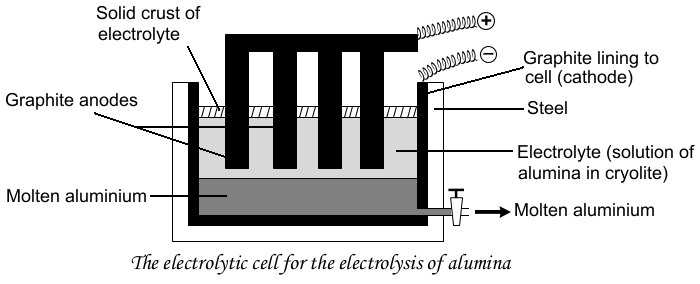
In molten cryolite, alumina ionises as follows:
Al₂O₃(s) → 2Al³⁺(l) + 3O²⁻(l)
Ions present in the electrolyte are: Al³⁺, Na⁺, O²⁻ and F⁻.
Reaction at the cathode: Al³⁺ ions gain electrons and are deposited as aluminium atoms.
Al³⁺(l) + 3e⁻ → Al(s)
The aluminium then melts, sinks to the bottom of the tank and is tapped off at intervals. The electrolyte forms a solid crust at the top which prevents the molten aluminium from atmospheric re-oxidation.
Reaction at the anode: O²⁻ ions lose electrons and oxygen gas is liberated.
2O²⁻(l) − 4e⁻ → O₂(g)
The oxygen released gradually burns away the graphite anode, oxidising it to carbon dioxide.
C(s) + O₂(g) → CO₂(g)
As a result, the anode has to be replaced from time to time, and this increases the economic cost of the process.
Remark: Because of the high current required for the aluminium extraction process, aluminium companies are usually located in places where there is a cheap source of electricity. In Cameroon, ALUCAM is located in Edea, where there is a hydroelectric power station.
Uses of Aluminium in Relation to its Properties
Aluminium is used in:
- Making overhead electric cables because it is light, i.e. it has a low density.
- Making roofing sheets because it is malleable, light and resistant to corrosion.
- Making cooking utensils because it is cheap, non-poisonous, light, resistant to corrosion and a good conductor of heat.
- Making paints because of its high reflectivity.
- Making alloys because it is light and resistant to corrosion. Duralumin, a lightweight aluminium alloy, is widely used in aircraft construction. Duralumin contains copper, magnesium and manganese.
The Extraction of Copper
Copper is one of the less reactive metals and is found in the free metallic form, i.e. in the native form, in a few places such as Canada and the USA. It occurs naturally in the following ores:
- Copper pyrites (CuFeS₂)
- Cuprite (Cu₂O)
- Malachite (CuCO₃.Cu(OH)₂)
- Copper glance (Cu₂S)
The principal ore from which copper is extracted is copper pyrites (CuFeS₂). It is extracted by thermal reduction of the ore, i.e. the ore is heated until it undergoes thermal decomposition.
The ore is first separated from the earthy impurities and then concentrated by froth flotation.
The purified ore is then roasted in air to form copper(I) sulphide, iron(II) oxide and sulphur dioxide gas, which is collected and used for other purposes such as the Contact Process.
2CuFeS₂(s) + 4O₂(g) → Cu₂S(s) + 2FeO(s) + 3SO₂(g)
Silica (sand) is added to the solid mixture obtained and then heated in the absence of air. The iron(II) oxide reacts with silica to form a molten slag of iron(II) silicate, which is then separated from the copper(I) sulphide.
Cu₂S(s) + FeO(s) + SiO₂(s) → FeSiO₃(l) + Cu₂S(s) (iron(II) silicate)
The copper(I) sulphide is reduced to metallic copper by heating in a limited supply of air.
Cu₂S(s) + O₂(g) → 2Cu(s) + SO₂(g)
Some of the copper(I) sulphide is instead converted to copper(I) oxide.
2Cu₂S(s) + 3O₂(g) → 2Cu₂O(s) + 2SO₂(g)
The copper(I) oxide is converted to metallic copper by auto-reduction with copper(I) sulphide.
Cu₂S(s) + 2Cu₂O(s) → 6Cu(s) + SO₂(g)
The copper obtained is crude or impure and is called blister copper. It is purified or refined by electrolysis, during which the impure copper is made the anode and a piece of pure copper is made the cathode of the electrolytic cell. The electrolyte is usually copper(II) sulphate solution (it must be a soluble salt containing Cu²⁺ ions).
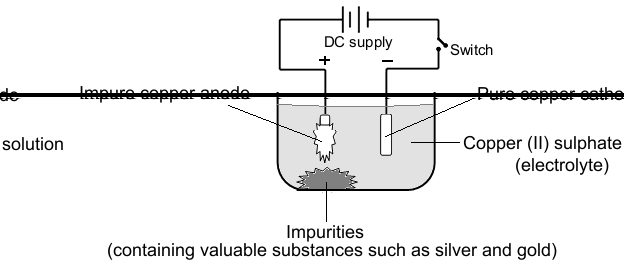
Reaction at the anode: Copper atoms lose two electrons each and go into solution as Cu²⁺ ions. The impurities are deposited at the bottom of the container. The anode thus reduces in size.
Cu(s) − 2e⁻ → Cu²⁺(aq) OR Cu(s) → Cu²⁺(aq) + 2e⁻
Reaction at the cathode: The Cu²⁺ ions each gain two electrons and are deposited as pure metallic copper on the cathode, which then increases in size. The cathode should therefore be made of pure copper to avoid re-contaminating the pure copper obtained with impurities.
Cu²⁺(aq) + 2e⁻ → Cu(s)
Uses of Copper in Relation to its Properties
- Copper is extensively used in making electric wires because it is a very good conductor of electricity.
- It is used in metalwork because it is resistant to corrosion and has an attractive appearance.
- It is used in making alloys such as brass (copper and zinc) and bronze (copper and tin).
The Extraction of Titanium
Titanium is a transition metal. In Cameroon, titanium is found in Akonolinga. It is extracted from the ores rutile (TiO₂) and ilmenite (FeTiO₃) by the Kroll process. This is a reduction process which involves two main stages:
The Preparation of Titanium(IV) Chloride from the Ores
After concentrating, the ore is heated in a stream of dry chlorine gas in the presence of carbon, and titanium(IV) chloride is obtained.
TiO₂(s) + C(s) + 2Cl₂(g) → TiCl₄(l) + CO₂(g)
OR
2FeTiO₃(s) + 3C(s) + 7Cl₂(g) → 2TiCl₄(l) + 2FeCl₃(s) + 3CO₂(g)
The titanium(IV) chloride obtained is purified by fractional distillation.
The Reduction of Titanium(IV) Chloride to Titanium
The titanium(IV) chloride is reduced to titanium by heating with either sodium or magnesium at a temperature of about 850℃ in an inert atmosphere of argon. The atmosphere of argon is necessary to prevent the titanium formed from reacting with oxygen and nitrogen present in air.
TiCl₄(l) + 4Na(s) → Ti(s) + 4NaCl(s)
OR
TiCl₄(l) + 2Mg(s) → Ti(s) + 2MgCl₂(s)
Uses of Titanium in Relation to its Properties
- It is used in the construction of aircraft and rockets because it is light, hard and resistant to corrosion.
- It is used in the construction of chemical plants and steam turbines because it is resistant to corrosion and is not easily attacked by chemicals like chlorine and acids.
- It is used in building nuclear reactors because it has a high tensile strength and a high melting point.