Plane Geometry, Vectors and Trigonometry
Geometry connects shape, size and position. Vectors describe directed movement, while trigonometry links angles to the sides of right-angled triangles.
Learning objectives
After studying these notes, learners should be able to define the main terms, apply the central rules and formulas, solve structured examples and explain each answer clearly.
Key ideas
- Similar and congruent figures
- Scale factors, perimeter and area ratios
- Column vectors and vector addition
- Magnitude and direction of a vector
- Sine, cosine and tangent ratios
- Bearings and angles of elevation or depression
Essential rules and formulas
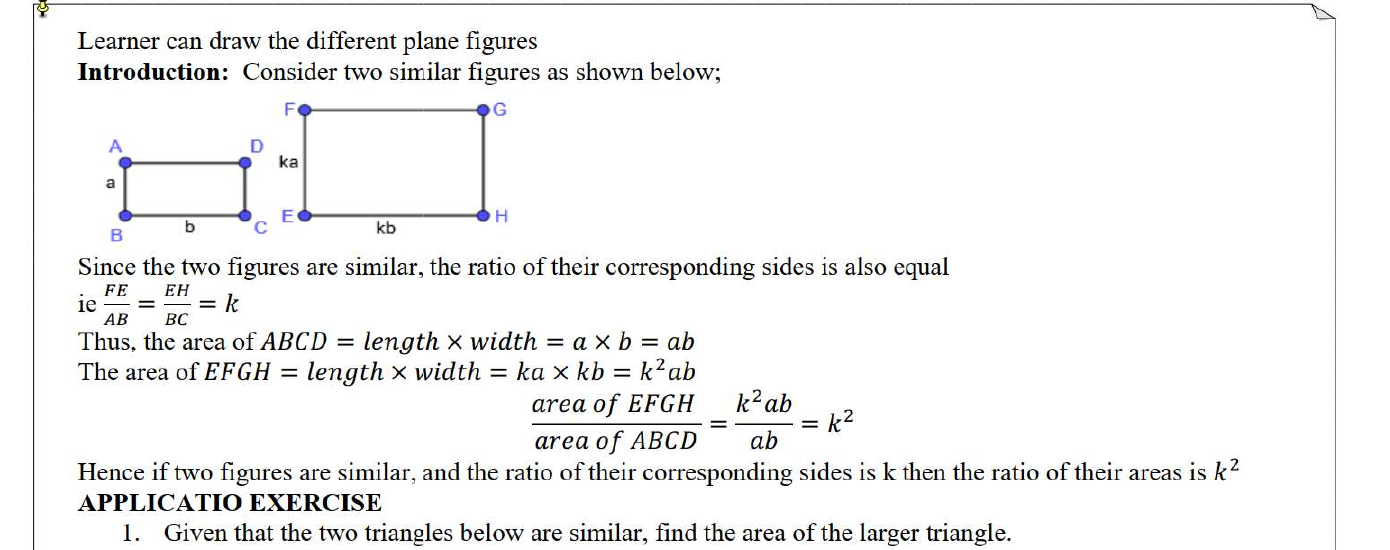
- If the linear scale factor is k, the area scale factor is k^2
- Magnitude of (x,y) = sqrt(x^2 + y^2)
- sin theta = opposite/hypotenuse
- cos theta = adjacent/hypotenuse
- tan theta = opposite/adjacent
Worked example
Two similar rectangles have corresponding sides in the ratio 3:5. Their areas are in the ratio 9:25. A rectangle of area 36 square units corresponds to one of area 100 square units.
Study method
Begin every problem by listing the information supplied and identifying the rule that connects it to the unknown quantity. Keep algebraic steps on separate lines, include units where required and check that the final result is reasonable.
Practice questions
- Find the missing side of a right triangle with hypotenuse 10 and angle 35 degrees.
- Add the vectors (3,-2) and (-1,5).
- A map uses a scale of 1:50,000. Find the real distance represented by 6 cm.
Revision checklist
- Can you state each definition without looking at the notes?
- Can you select the correct formula and substitute values accurately?
- Can you explain the reasoning behind each step?
- Can you solve a similar examination question independently?