Coordinate Geometry
Coordinate geometry uses algebra to describe points, lines and geometric relationships on the Cartesian plane.
Learning objectives
After studying these notes, learners should be able to define the main terms, apply the central rules and formulas, solve structured examples and explain each answer clearly.
Key ideas
- Coordinates and quadrants
- Midpoint and distance
- Gradient of a line
- Equations in slope-intercept and point-slope forms
- Parallel and perpendicular lines
- Intersection of straight lines
Essential rules and formulas
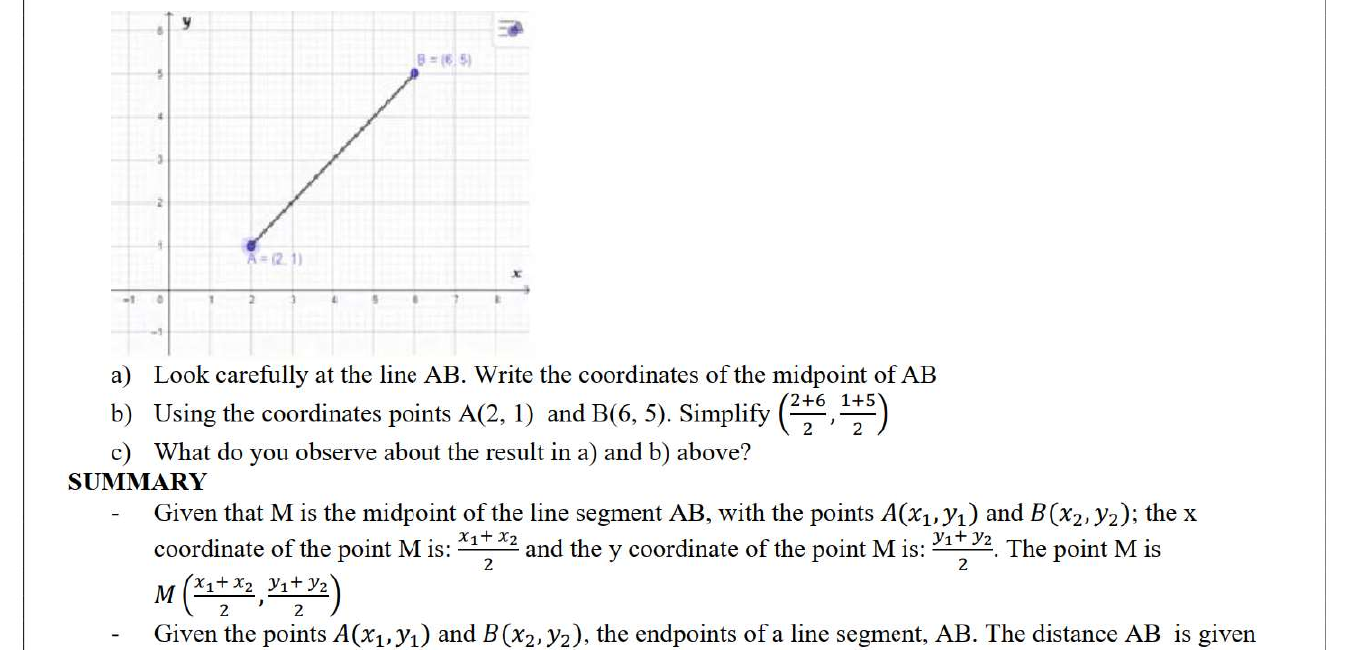
- Midpoint = ((x1+x2)/2, (y1+y2)/2)
- Distance = sqrt((x2-x1)^2+(y2-y1)^2)
- Gradient m = (y2-y1)/(x2-x1)
- Line equation: y-y1 = m(x-x1)
- For perpendicular lines, m1 x m2 = -1
Worked example
For A(2,1) and B(6,5), the midpoint is (4,3), the gradient is 1 and the distance is sqrt(32)=4sqrt(2).
Study method
Begin every problem by listing the information supplied and identifying the rule that connects it to the unknown quantity. Keep algebraic steps on separate lines, include units where required and check that the final result is reasonable.
Practice questions
- Find the equation of the line through (1,4) and (5,12).
- Find the perpendicular bisector of the segment joining (2,3) and (8,7).
- Determine the intersection of y=2x+1 and y=-x+7.
Revision checklist
- Can you state each definition without looking at the notes?
- Can you select the correct formula and substitute values accurately?
- Can you explain the reasoning behind each step?
- Can you solve a similar examination question independently?