Members and electronic structure
The halogens are Group VII or Group 17 elements: fluorine, chlorine, bromine, iodine and astatine. Their outer configuration is ns²np⁵, and they exist as diatomic molecules, X₂.
Physical trends
Molecular size and molar mass increase down the group, strengthening van der Waals forces. Melting and boiling points therefore increase, and the physical state changes from gases at the top to liquid bromine and solid iodine.
Reactivity and displacement
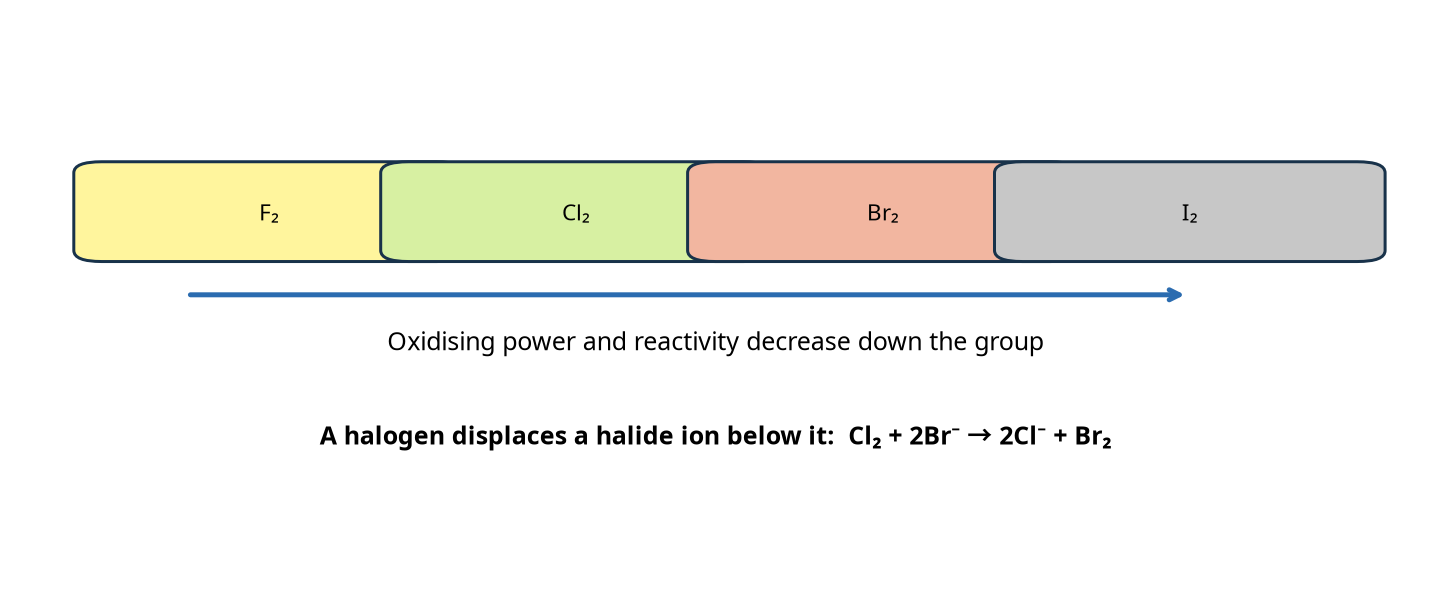
Reactivity and oxidising power decrease down the group. A more reactive halogen displaces a less reactive halide ion: Cl₂ + 2Br⁻ → 2Cl⁻ + Br₂. The order is F₂ > Cl₂ > Br₂ > I₂.
Laboratory preparation of chlorine
MnO₂ + 4HCl → MnCl₂ + Cl₂ + 2H₂O. The gas is washed, dried with concentrated sulfuric acid and collected by downward delivery. Chlorine is poisonous and must be prepared in a fume cupboard.
Reactions and uses
Chlorine reacts with water: Cl₂ + H₂O ⇌ HCl + HClO. Hypochlorous acid gives bleaching and disinfecting action. Industrial chlorine is produced by electrolysis of concentrated brine and is used in water treatment and plastic manufacture.
Tests for halide ions
Acidify with dilute nitric acid and add silver nitrate. Chloride gives a white precipitate soluble in aqueous ammonia; bromide gives cream, partly soluble precipitate; iodide gives yellow, insoluble precipitate.