Definition
An information system (IS) is a set of integrated elements or components that collect, manipulate and disseminate information and provide a feedback mechanism to meet an objective. The minimal information system consists of people, procedures and data. A Computer-Based Information System (CBIS) uses computer technology as the main component, e.g. computerized library, hospital, school management, reservation and payroll systems.
Components of an Information System
- Data and Information: data is raw facts and figures; information is data processed into a useful, meaningful form.
- Hardware: the physical technology that works with information, from a smartphone to a supercomputer.
- Software: tells the hardware what to do.
- Networks: allow diverse computers to distribute resources, wired or wireless.
- Databases and data warehouses: a database is organized for storage, accessibility and retrieval; a data warehouse collects data from single or multiple sources for reporting and analysis.
- Procedures: the commands for combining the components above to produce the preferred output.
- People (users): operate the hardware and create and use the software.
Advantages of CBIS
- Many people can access information at the same time through a network.
- Large filing cabinets are replaced by the computer’s large storage capacity.
- Saves time, resources and money by processing information automatically.
- Facilitates communication and resource sharing over a network.
- Provides fast, accurate information to support decision making, improves productivity and reduces duplication of information.
Disadvantages of CBIS
- Security is needed to protect data/information, and users must be trained to use the system.
- Computers hold personal information which may be misused, and systems are expensive to develop.
- If the system crashes, all data/information can be lost.
Information Systems in the Organization
An organization is a social unit of people structured and managed to pursue collective goals, with well-defined authority, a co-operative relationship, specific objectives, division of activities and its own identity. A typical organization has six functional areas: Accounting, Marketing, Human Resource, Production, Research, and Information Technology.
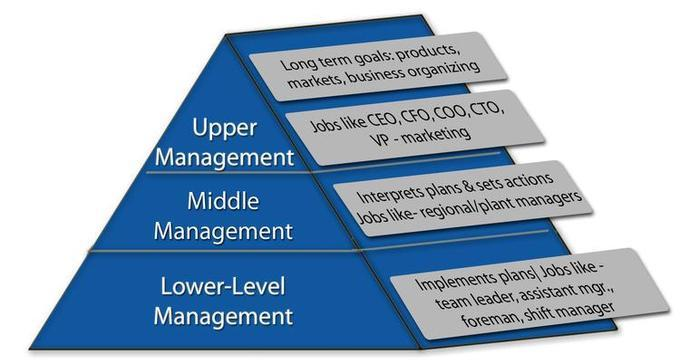
There are three levels of management: Strategic Management (top-level, sets long-term goals and direction), Tactical Management (middle-level, develops goals and strategies based on strategic direction), and Operational Management (lower-level, manages day-to-day operations).
Information in an organization can be internal (describing operational aspects), external (describing the surrounding environment), objective (describing something known) or subjective (describing something not yet known). Its flow is typically vertical (upward/downward) and horizontal: downward flow carries strategies and directives, upward flow reports the current state of the organization, and horizontal flow passes between departments at the same level.