Derived Logic Gates
Using combinations of the basic gates, more complex logic gates can be built:
- NAND gate: a NOT-AND combination — the output is LOW (0) only when all inputs are HIGH (1), otherwise the output is HIGH (1).
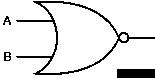
- NOR gate: a NOT-OR combination — the output is HIGH (1) only when all inputs are LOW (0), otherwise the output is LOW (0).
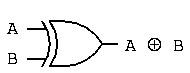
- Exclusive-OR (XOR): an inequality function — the output is HIGH (1) when the input variables are not equal to each other.
- Exclusive-NOR (XNOR): an equality function — the output is HIGH (1) when the inputs are equal to each other.

Boolean Algebra
Boolean algebra is a mathematical system developed by the English mathematician George Boole, used to formulate logical statements with symbols so problems can be solved in a definite manner, similar to ordinary algebra. Since it deals with the binary number system, variables in Boolean equations have only two possible values (0 or 1).
Rules of Boolean Algebra
| Addition Rules | Multiplication Rules |
|---|---|
| 0 + 0 = 0 | 0 · 0 = 0 |
| 0 + 1 = 1 | 0 · 1 = 0 |
| 1 + 0 = 1 | 1 · 0 = 0 |
| 1 + 1 = 1 | 1 · 1 = 1 |
| A + 0 = A | A · 0 = 0 |
| A + 1 = 1 | A · 1 = A |
| A + A = A | A · A = A |
| A + Ā = 1 | A · Ā = 0 |
| A + AB = A | A + ĀB = A + B |
| (A + B)(A + C) = A + BC | AC + BC = A(B+C) |
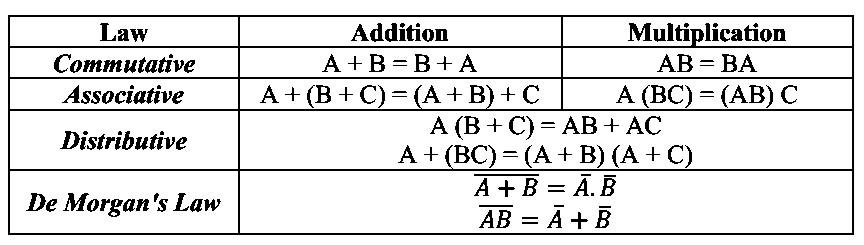
Laws of Boolean Algebra
- Complement law: A·Ā = 0, A + Ā = 1
- Idempotence law: A·A = A, A + A = A
- Absorption law: A(A + B) = A, A + (AB) = A
- Involution law: the complement of the complement of A is A
- Identity law: A·1 = A, A + 0 = A