What is a Network Topology?
A network topology is the study of the arrangement or mapping of the elements of a network, especially the physical and logical interconnections between nodes. It is also the name given to the physical layout or shape of a network.
Types of Network Topologies
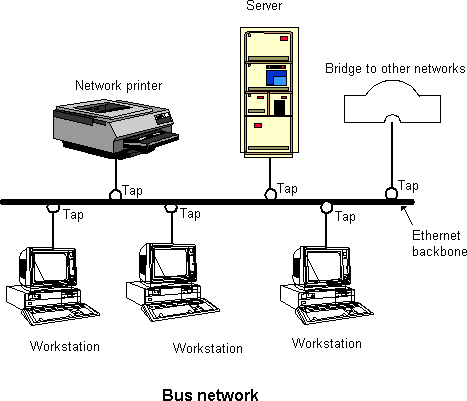
- Bus topology: a single cable joins all the workstations, printers, file servers, and other components together. The network transmits data in both directions, and each end of the bus has a “terminator” that prevents signals bouncing back and forth (echoes). The destination address must be included in each transmission.
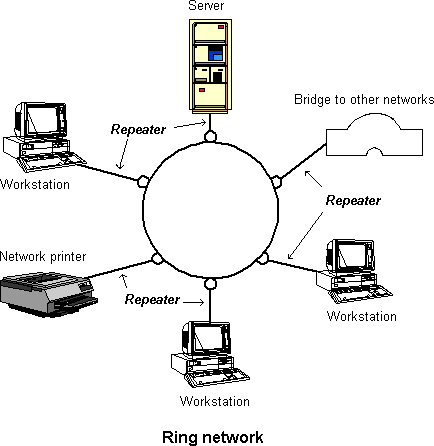
- Ring topology: all computers are connected to one another by a cable that forms a closed loop or ring. Data travels along the entire ring from one computer to the next, in one direction, until it reaches its destination. If a single machine is switched off, the network stops working, though extra computers can be added with little effect on performance.
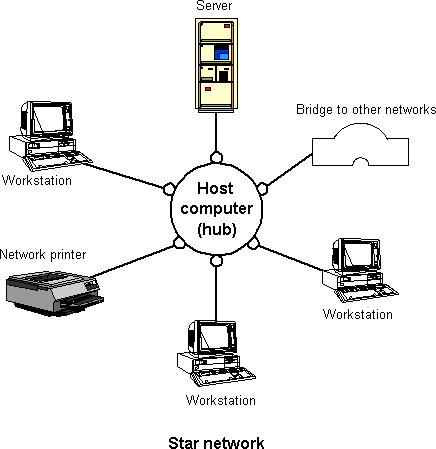
- Star topology: each workstation or communication device is connected to a central computer or server by its own unique link. This common connection point is called a hub, and all data passes through it. Star networks are commonly used in schools and offices because they tend to be the most reliable of the topologies.
- Tree topology: combines the characteristics of bus and star topologies. It is made up of branches that indirectly meet at a control point and offers only one transmission path between any two stations. Nodes are arranged hierarchically, so it is also called a hierarchical topology.
- Mesh topology: contains characteristics of all the topologies above and is common in very large networks such as the internet. It has multiple message channels between nodes, with each node connected to a number of neighbours so that there is at least one path from any node to any other.