Relative masses
Relative atomic mass compares an atom with one-twelfth of carbon-12. Relative molecular mass is the sum of the relative atomic masses in a molecule.
The mole and Avogadro constant
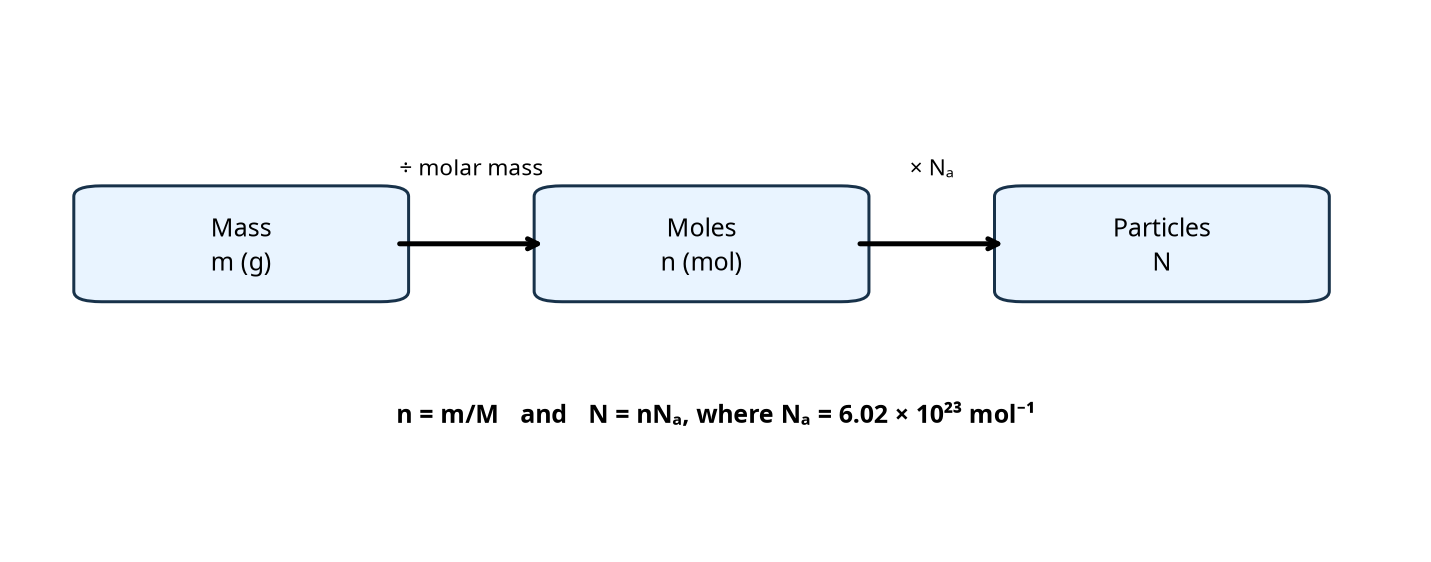
One mole contains approximately 6.02 × 10²³ particles. This is Avogadro’s constant, Nₐ. Molar mass is the mass of one mole in grams per mole.
Core equations
n = m/M, where n is amount in moles, m mass in grams and M molar mass. N = nNₐ gives the number of particles. For solutions, c = n/V, where c is mol dm⁻³ and V is volume in dm³.
Empirical and molecular formulae
Convert each mass or percentage into moles, divide by the smallest amount and multiply to obtain whole numbers. Multiply the empirical formula by an integer factor to obtain the molecular formula.
Stoichiometry
Balanced equations provide mole ratios. In 2H₂ + O₂ → 2H₂O, 2 mol hydrogen react with 1 mol oxygen. Always balance before calculation.
Molar volume of gases
At room temperature and pressure, one mole of gas occupies approximately 24 dm³, so n = V/24 when V is in dm³. Follow the convention stated in the question.
Common calculation method
- Write and balance the equation.
- Convert the known quantity to moles.
- Apply the mole ratio.
- Convert to the requested mass, volume, particles or concentration.