Chemical Kinetics
Chemical kinetics is the study of rates or speeds of chemical reactions. The rate of a chemical reaction expresses how fast reactants are converted into products or how fast products are formed from the reactants.
Definition: The rate or speed of a chemical reaction is the change in concentration or amount of a reactant or a product per unit time.
Rate of reaction = (Change in concentration or amount of a reactant or a product) ÷ (Time taken)
Measurement of Reaction Rates
The rate of a chemical reaction can be monitored as follows:
- By chemical analysis, where titration is used to determine the change in concentration of a product or a reactant per unit time. Change in concentration is however difficult to measure in most chemical reactions.
- By physical methods, where observable physical properties of chemical reactions that change proportionately with the concentration of a reactant or a product are used to monitor the rates of such reactions. Examples of physical properties which vary proportionately with concentrations of reactants or products in chemical reactions are: the volume of a gaseous product, change in temperature, colour intensity of the reaction mixture, change in mass, and change in pH.
The Collision Theory and Activation Energy
According to the collision theory, chemical reactions occur due to collisions between reactant particles. These reactant particles must also possess a certain minimum amount of energy called the activation energy (EA) for a reaction to occur.
Definition: Activation energy is the minimum amount of energy that reactant particles must possess before collisions between them will lead to a chemical reaction.
Factors Affecting the Rates of Chemical Reactions
The following factors affect the rates of chemical reactions:
- The concentration of reactants.
- The temperature of the reaction system.
- The surface area of solid reactants.
- The pressure of gaseous reactants for reactions in the gas phase.
- The presence of a catalyst.
- The presence of light.
The Effect of Concentration
An increase in the concentration of reactants increases the rate of a chemical reaction while a decrease in the concentration of reactants reduces the rate. An increase in the concentration of reactants increases the number of reactant particles and brings them closer to each other. This increases the frequency of collision between the particles, leading to an increase in the rate of reaction.
Investigating the Effect of Concentration: Magnesium and Dilute Hydrochloric Acid
Requirements: Magnesium ribbon, a conical flask, a gas syringe, a stop clock and dilute hydrochloric acid of different concentrations, e.g. 1.0M, 2.0M, 3.0M.
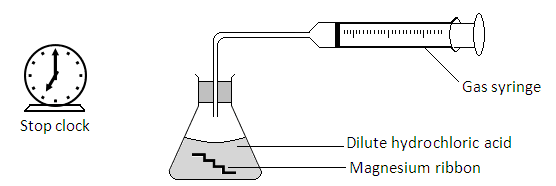
Procedure: 100cm³ of 1.0M HCl is measured and put into the conical flask, 5g of magnesium ribbon is added to it and the stop clock is started immediately. Magnesium reacts with the acid producing hydrogen gas which is collected in a graduated gas syringe.
Mg(s) + 2HCl(aq) → MgCl₂(aq) + H₂(g)
The volume of hydrogen gas is read at regular time intervals and recorded until two successive readings agree, showing that the reaction has gone to completion. The experiment is repeated using 100cm³ each of 2.0M HCl and 3.0M HCl with 5g of magnesium.
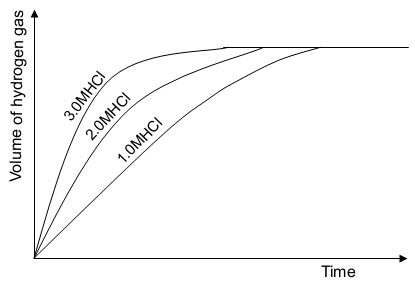
Observation: Graphs of volume of hydrogen against time for each concentration of HCl, plotted on the same axes, show that the curve for 3.0M HCl is the steepest (largest gradient) while that for 1.0M HCl has the least gradient.
Conclusion: The higher the concentration of the acid, the steeper the curve and hence the faster the rate of reaction; the rate of a chemical reaction increases with an increase in the concentration of the reactants.
The Effect of Temperature
The rate of a reaction increases with an increase in the temperature of the reaction system and decreases with a decrease in temperature. An increase in temperature increases reaction rate because the reactant particles gain more kinetic energy and move faster, so the frequency of collision between them increases, and more reactant particles acquire the activation energy and thus react faster.
Investigating the Effect of Temperature: Sodium Thiosulphate and Hydrochloric Acid
Requirements: Sodium thiosulphate, hydrochloric acid, a conical flask, a piece of white paper, and a stop clock.
Procedure: 30cm³ of 0.05M sodium thiosulphate solution at 25℃ is measured and put into a conical flask, which is placed on a cross marked on a white piece of paper. 25cm³ of 2.0M HCl is added and the stop clock is immediately started. Yellow sulphur is precipitated as the two substances react, causing the mixture to turn cloudy.
Na₂S₂O₃(aq) + 2HCl(aq) → 2NaCl(aq) + H₂O(l) + SO₂(g) + S(s)

Immediately the cross becomes invisible, the clock is stopped and the time taken for the cross to disappear is recorded. The experiment is repeated using the same volumes and concentrations of hydrochloric acid and sodium thiosulphate at 30℃ and 40℃.
Observation: The cross is found to disappear fastest at the highest temperature. The time taken for the cross to disappear reduces as temperature increases; hence the speed of the reaction is inversely proportional to the time taken for the reaction to go to completion, i.e. Rate of reaction ∝ 1/Time taken.
Conclusion: The higher the temperature of a reaction system, the faster the rate of the reaction.
The Effect of Surface Area
The surface area of a solid reactant affects the rate of a heterogeneous reaction but does not affect the rate of a homogeneous reaction. A heterogeneous reaction is one in which the reactants are in different phases, e.g. solids/gases, solids/liquids etc. A homogeneous reaction is one in which all reactants are in the same phase, i.e. either all solids, liquids or gases.
The rate of a heterogeneous reaction increases when the surface area of a solid reactant is increased by powdering or breaking the solid into tiny particles. A powdered substance exposes a larger surface area which brings the reactant particles into more intimate contact; hence they collide more frequently and therefore react faster.
Investigating the Effect of Particle Size: Calcium Carbonate and Hydrochloric Acid
Requirements: lumps of marble chips, powdered marble, 2.0M hydrochloric acid, a conical flask, a chemical balance, a stop clock and a piece of cotton wool.
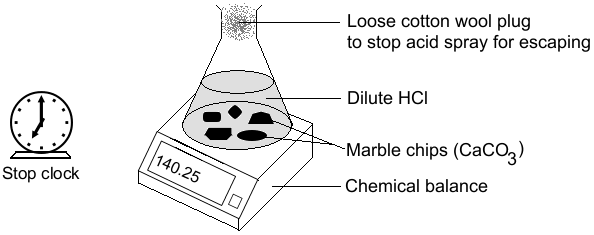
Procedure: 50cm³ of 2.0M HCl is put into a conical flask standing on a chemical balance, 5g of marble chips is added to it, the initial mass of the flask and its content is noted and the stop clock is immediately started. The marble chips react with the HCl producing carbon dioxide gas which is allowed to escape, leading to a loss in mass of the flask and its content.
CaCO₃(s) + 2HCl(aq) → CaCl₂(aq) + H₂O(l) + CO₂(g)
A loose cotton wool plug is placed at the mouth of the conical flask to prevent any acid spraying out of the flask. The mass of the flask and content is noted at regular time intervals and, in each case, loss in mass is calculated as: initial mass − mass at each interval. The experiment is repeated with 5g of powdered marble using the same volume and concentration of HCl as in the first experiment.
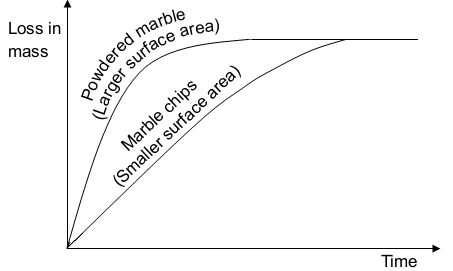
Observation: Graphs of loss in mass against time for marble chips and powdered marble, plotted on the same axes, show that the curve for powdered marble is steeper than that for marble chips. Also, effervescence is more vigorous and stops earlier for powdered marble than for marble chips.
Conclusion: Increasing the surface area of solid reactants (by powdering) increases the rate of reaction.
The Effect of a Catalyst
A catalyst is a substance which can alter the rate of a chemical reaction but remains chemically unchanged at the end of the reaction. Most catalysts increase the rate of a chemical reaction and are called positive catalysts. A few catalysts slow down the rate of a reaction and are called negative catalysts or inhibitors.
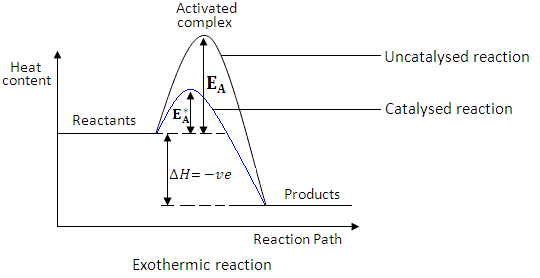
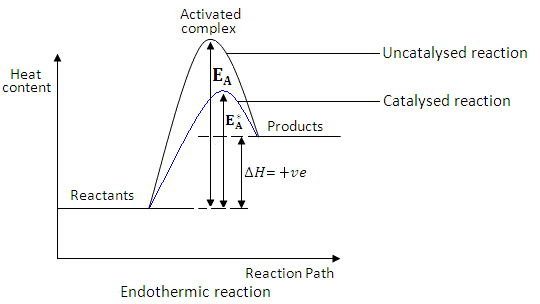
A catalyst increases the rate of a chemical reaction by lowering the activation energy, making it possible for many more reactant particles to cross the energy barrier so that collisions between them lead to chemical reactions. For reactions in the gaseous phase, a solid catalyst, apart from lowering the activation energy, also increases the reaction rate by providing a larger surface area for the reacting gases.
In both diagrams: EA = activation energy for the uncatalysed reaction; EA* = activation energy for the catalysed reaction; EA* < EA due to the effect of the catalyst.
Investigating the Effect of a Catalyst: Decomposition of Hydrogen Peroxide
Requirements: Hydrogen peroxide, manganese(IV) oxide, a conical flask, a gas syringe and a stop clock.
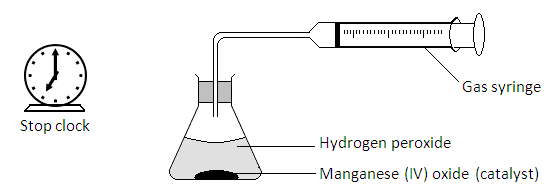
Procedure: 50cm³ of hydrogen peroxide is put into the conical flask, 1g of manganese dioxide (catalyst) is added and the stop clock is started immediately. The hydrogen peroxide decomposes, releasing oxygen gas which is collected in the gas syringe.
2H₂O₂(l) → 2H₂O(l) + O₂(g)
The volume of oxygen gas is measured at regular time intervals until two successive values agree, showing that the reaction has gone to completion. The experiment is repeated without the catalyst, using the same volume of hydrogen peroxide as in the first case.
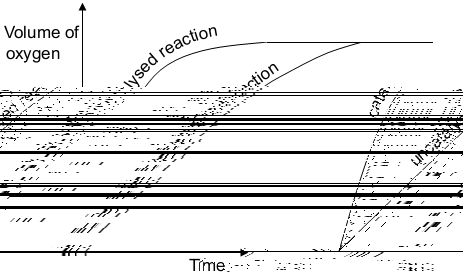
Observation: Graphs of volume of gas against time for both experiments, plotted on the same axes, show that the curve for the catalysed reaction is steeper than that for the uncatalysed reaction.
Conclusion: The catalyst increased the rate of decomposition of hydrogen peroxide.
The Effect of Light
The presence of light increases the rates of some chemical reactions. Such reactions are called photochemical reactions. Examples are photosynthesis, the reaction between hydrogen and chlorine, the reaction between methane and chlorine, and the decomposition of silver chloride. On absorbing light energy, reactant particles become activated and collide more frequently, thus reacting faster.
The Effect of Pressure
Pressure affects the rates of gas phase reactions only. An increase in the total pressure of the reaction system brings the reactant particles closer to each other, so they collide more frequently, leading to an increase in reaction rate. A decrease in pressure leads to the reactant particles being further apart and thus fewer collisions occur; as a result, the reaction rate decreases.