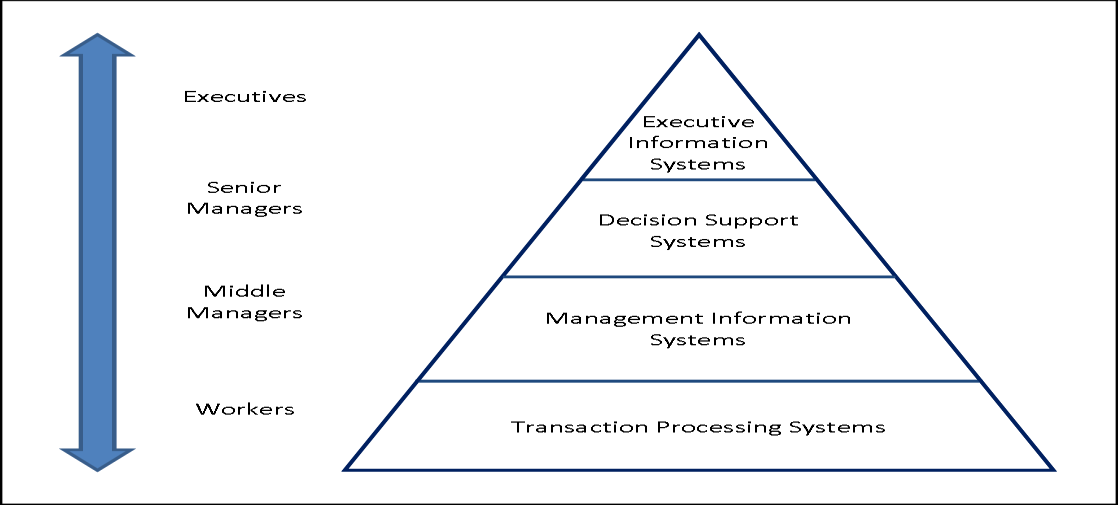
In any organization, information systems can be classified using a four-level model based on who uses them: workers, middle managers, senior managers and executives.
1. Transaction Processing System (TPS)
Operated directly by shop floor or front-line staff, providing the key data needed to support day-to-day operations through automated tracking of low-level activities. Examples: payroll systems, order processing, reservations, stock control, payments.
Characteristics: produce information for other systems; used by operational and supervisory staff; efficiency oriented.
2. Management Information Systems (MIS)
Used by middle managers to help ensure the smooth running of the organization in the short to medium term, by comparing current with previous outputs. Examples: sales management, inventory control, budgeting, Management Reporting Systems (MRS), Personnel (HRM) systems.
Characteristics: support relatively structured decisions; used by lower and middle managerial levels; deal with the past and present rather than the future.
3. Decision Support Systems (DSS)
Knowledge-based systems used by senior managers to analyse existing structured information and project the potential effects of decisions into the future. Examples: logistics systems, financial planning systems.
Characteristics: support all-structured or semi-structured decisions; analytical/modeling capacity; used by senior managers; concerned with predicting the future.
4. Executive Information Systems (EIS)
Strategic-level systems at the top of the pyramid that help executives analyse the environment, identify long-term trends and plan courses of action, using weakly structured information from internal and external sources.
Characteristics: concerned with ease of use and predicting the future; effectiveness oriented; highly flexible; support unstructured decisions; used only at the most senior management levels.