Advanced Level Further Pure Mathematics: Sequences and Series
A sequence is an ordered list of numbers, usually written (un). It may be defined explicitly by a formula for un, or recursively by giving a starting value and a rule linking consecutive terms.
1. Explicit and recursive definitions
An explicit sequence has the form un = f(n). For example, un = 3n − 2 gives 1, 4, 7, 10, … when n begins at 1. A recursive sequence such as u0 = 2 and un+1 = ½un + 3 is generated one term at a time.
2. Monotonicity
A sequence is increasing if un+1 ≥ un, decreasing if un+1 ≤ un, and strictly monotone when the inequality is strict. To study monotonicity, examine un+1 − un or, for positive terms, un+1/un.
Example: For un = n/(n+1), un+1 − un = 1/[(n+1)(n+2)] > 0. Therefore the sequence is strictly increasing.
3. Bounded sequences
A sequence is bounded above if un ≤ M for every n, and bounded below if un ≥ m. If both conditions hold, the sequence is bounded. A monotone increasing sequence that is bounded above converges; a monotone decreasing sequence that is bounded below also converges.
4. Limits and convergence
If un approaches a finite number L as n becomes arbitrarily large, write lim un = L. Standard strategies include dividing numerator and denominator by the highest power of n, using known limits, applying the squeeze theorem and comparing dominant terms.
5. Graphical representation of a recurrence
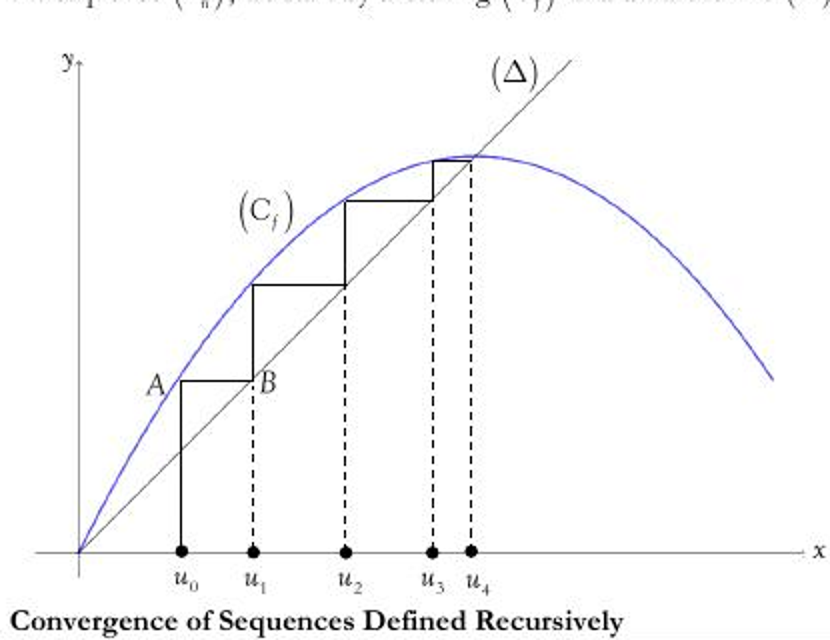
For un+1 = f(un), draw y=f(x) together with y=x. Starting at u0 on the x-axis, move vertically to y=f(x), horizontally to y=x, and repeat. The resulting staircase or cobweb diagram shows whether terms approach or move away from a fixed point.
6. Arithmetic sequences and series
For first term a and common difference d:
un = a + (n−1)d
Sn = n/2[2a + (n−1)d] = n/2(a + l)
where l is the final term.
7. Geometric sequences and series
For first term a and common ratio r:
un = arn−1
Sn = a(1−rn)/(1−r), r ≠ 1.
If |r| < 1, the infinite series converges to S∞ = a/(1−r).
8. Tests and telescoping
If the terms of an infinite series do not tend to zero, the series diverges. For a telescoping series, use partial fractions or rearrangement so that most terms cancel. Always write several terms before stating the remaining first and last terms.
Worked example
Let u0=2 and un+1=(un+6)/3. A possible limit satisfies L=(L+6)/3, so L=3. Also un+1−3=(un−3)/3, hence un−3=−1/3n. Therefore un=3−3−n and un→3.
Practice questions
- Show that un=(2n+1)/(n+2) is increasing and bounded above.
- For u0=4 and un+1=√(2un+3), conjecture and prove the limit.
- Find the sum of the first 20 terms of 7, 11, 15, …
- Determine the sum to infinity of 12−6+3−3/2+…
- Evaluate Σr=1n1/[r(r+1)] and hence find its limit.