Vector Product and Its Applications
The vector or cross product combines two vectors in three-dimensional space to produce a vector perpendicular to both. It is central to problems involving normals, areas, volumes and coplanarity.
1. Definition
For non-zero vectors a and b making an angle θ,
a × b = |a||b|sinθ n̂
where n̂ is the unit normal determined by the right-hand rule. Thus |a×b| is the area of the parallelogram whose adjacent sides are a and b.
2. Component formula
If a=(a₁,a₂,a₃) and b=(b₁,b₂,b₃), then
a×b = (a₂b₃−a₃b₂)i − (a₁b₃−a₃b₁)j + (a₁b₂−a₂b₁)k.
The middle component carries the negative sign when the determinant is expanded along the first row.
3. Properties
- a×b = −(b×a).
- a×a = 0.
- a×(b+c)=a×b+a×c.
- a×b=0 exactly when a and b are parallel, provided neither is zero.
4. Areas
The area of a parallelogram with adjacent vectors a and b is |a×b|. The area of the triangle is half this value. For a quadrilateral whose diagonals are d₁ and d₂, the area is ½|d₁×d₂|.
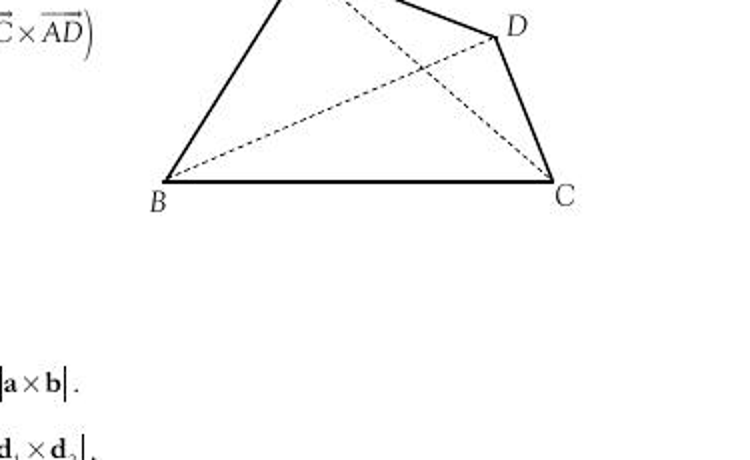
Example: Let a=(1,2,3) and b=(3,−2,1). Then a×b=(8,8,−8), so the parallelogram area is √(64+64+64)=8√3 square units.
5. Scalar triple product
The scalar triple product is (a×b)·c. Its absolute value is the volume of the parallelepiped formed by the three vectors:
V = |(a×b)·c|.
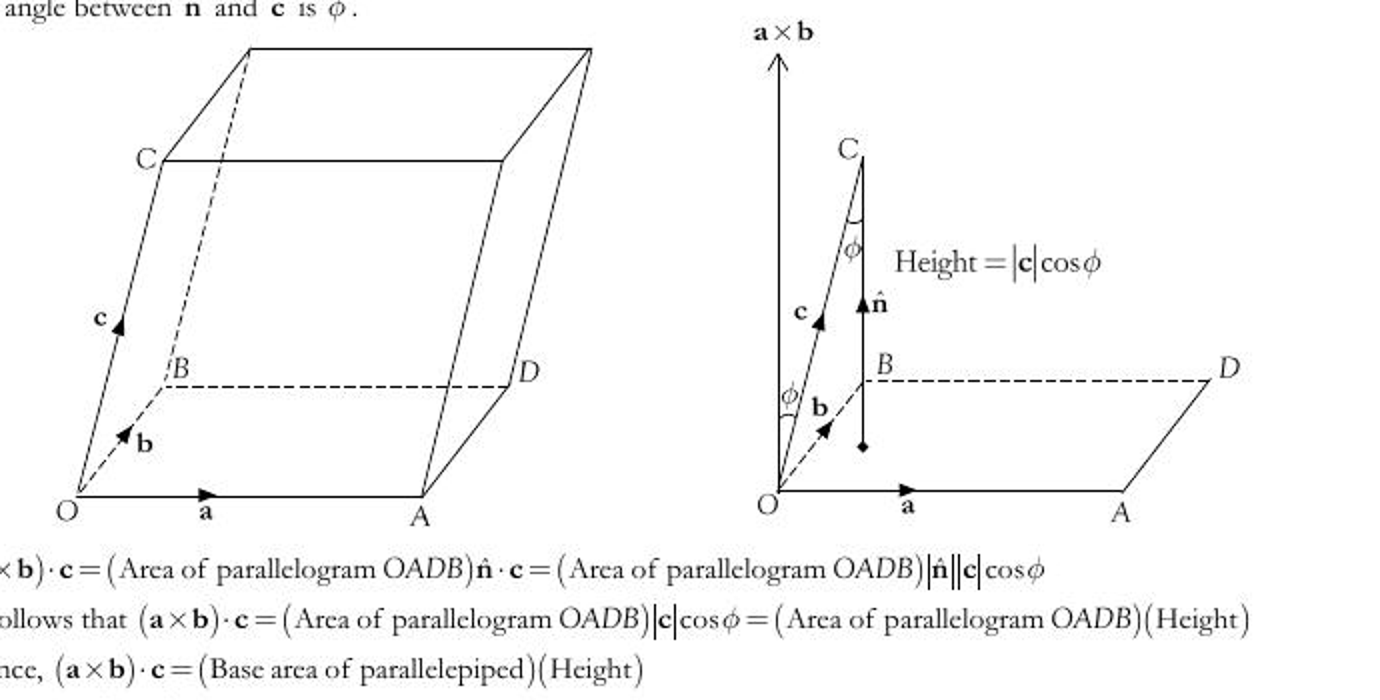
In components, the triple product equals the determinant whose rows or columns are the components of a, b and c. Cyclic permutations do not alter its value, while interchanging two vectors changes its sign.
6. Coplanarity and tetrahedra
Three vectors are coplanar if and only if (a×b)·c=0. The volume of a tetrahedron with three coterminous edge vectors is one sixth of the associated parallelepiped volume.
Vtetrahedron = 1/6 |(a×b)·c|.
7. Unit normals
A unit vector perpendicular to both a and b is ±(a×b)/|a×b|. The sign depends on the required orientation.
Worked example
Find a unit normal to a=(1,−2,3) and b=(2,1,−1). We obtain a×b=(−1,7,5), with magnitude √75=5√3. Therefore a unit normal is (−i+7j+5k)/(5√3); its negative is the other possible answer.
Practice questions
- Find the angle between a=(3,−2,4) and b=(1,−1,0) using the cross product.
- Find the area of the triangle with vertices A(3,−1,2), B(1,−1,−3) and C(4,−3,1).
- Find the volume of the parallelepiped generated by (1,2,0), (2,−1,3) and (0,4,1).
- Determine whether the points A, B, C and D with given position vectors are coplanar by using a scalar triple product.
- Prove that |a×b|²=|a|²|b|²−(a·b)².