Alkanes (The Paraffins)
Alkanes are saturated hydrocarbons, i.e. they contain carbon to carbon single bonds. They form a homologous series with the general formula CnH2n+2, where n is a whole number that can take values such as 1, 2, 3…
Nomenclature of Alkanes
Alkanes are named according to the IUPAC rules. The root is derived from the longest carbon chain in the alkane. This carbon chain is numbered such that the carbon atom bearing any side chain or prefix takes the smallest possible number. The name begins with prefixes (if any) and ends with the suffix –ane.
The first five members of this homologous series are given in the following table.
| Alkane | Molecular Formula | Structural Formula |
|---|---|---|
| Methane | CH₄ | CH₄ |
| Ethane | C₂H₆ | CH₃CH₃ |
| Propane | C₃H₈ | CH₃CH₂CH₃ |
| Butane | C₄H₁₀ | CH₃CH₂CH₂CH₃ |
| Pentane | C₅H₁₂ | CH₃CH₂CH₂CH₂CH₃ |
General Physical Properties of Alkanes
- Alkanes with 1 to 4 carbon atoms, i.e. methane, ethane, propane and butane, are gaseous at r.t.p. Those with 5 to 7 carbon atoms are volatile liquids, while those with 8 to 16 carbon atoms are heavy liquids and wax-like solids.
- The melting and boiling points of alkanes increase as the number of carbon atoms per molecule increases.
Methane
Methane is the simplest alkane. It is the major constituent of natural gas and is usually present in petroleum gas. Methane is given off from swamps and stagnant ponds due to the decomposition of organic matter in the absence of air. Hence it is sometimes referred to as marsh gas.
Laboratory Preparation of Methane
Methane is prepared in the laboratory by heating a mixture of anhydrous sodium ethanoate (sodium acetate) and an alkali, usually soda-lime (which is quicklime slaked with concentrated sodium hydroxide solution). The soda-lime thus acts as a source of sodium hydroxide and is preferred to pure sodium hydroxide because of the following reasons:
- It is not deliquescent.
- It does not attack glass readily.
Apparatus: The following apparatus is used to prepare methane in the laboratory.
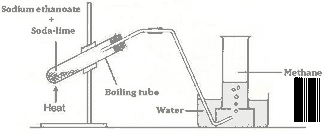
Procedure:
- A powdered mixture of sodium ethanoate and soda-lime is heated gently in a boiling tube.
- The substances react together, releasing methane as follows:
CH₃COONa(sodium ethanoate) + NaOH(s)(from soda-lime) → Na₂CO₃(aq) + CH₄(g)
- The methane gas produced is collected over water because it is slightly soluble in water.
Remark: The other alkanes in the homologous series can be similarly prepared by heating an appropriate sodium salt of a carboxylic acid and soda-lime, e.g. ethane is prepared by heating sodium propanoate and soda-lime.
CH₃CH₂COONa(sodium propanoate) + NaOH(s)(from soda-lime) → Na₂CO₃(aq) + CH₃CH₃(g)
Physical Properties of Methane
- It is colourless and odourless.
- It is less dense than air.
- It is neutral to litmus.
- It is slightly soluble in water.
Uses of Methane
- Methane is used mainly as a fuel, either by itself or mixed with other gases.
- It is used in the manufacture of anaesthetics (used for surgical operations) and organic solvents like trichloromethane (chloroform), carbon tetrachloride or tetrachloromethane.
- It is used in the industrial manufacture of hydrogen by steam re-forming.
Chemical Properties of Alkanes
- Combustion: Alkanes burn exothermically in oxygen with a non-luminous blue flame that is non-smoky because they have a low carbon to hydrogen ratio.
- A mixture of methane and air explodes violently when ignited and burns, producing carbon dioxide and water vapour.
CH₄(g) + 2O₂(g) → 2H₂O(g) + CO₂(g)
This reaction is the main cause of explosions in coal mines.
- Butane, which is the main component of cooking gas, burns in oxygen as follows:
2C₄H₁₀(g) + 13O₂(g) → 10H₂O(g) + 8CO₂(g)
- Substitution reactions: A substitution reaction is a reaction in which an atom (or a group of atoms) in an organic molecule is replaced by another atom (or group of atoms) from an added reagent.
Methane, like other alkanes, undergoes substitution reactions with chlorine in the presence of ultraviolet radiation from sunlight (which acts as a photochemical catalyst).
CH₄(g) + Cl₂(g) →U.V. CH₃Cl(g)(chloromethane) + HCl(g)
The hydrogen atoms in the chloromethane can equally be substituted as follows:
CH₃Cl(g) + Cl₂(g) →U.V. CH₂Cl₂(g)(dichloromethane) + HCl(g)
CH₂Cl₂(g) + Cl₂(g) →U.V. CHCl₃(l)(trichloromethane) + HCl(g)
CHCl₃(l) + Cl₂(g) →U.V. CCl₄(l)(tetrachloromethane) + HCl(g)