Thermochemistry
Thermochemistry is the study of heat change in chemical reactions.
Enthalpy (H)
It is the energy content of a system. It is denoted by H.
Enthalpy Change (ΔH)
The enthalpy change (or energy change) in a chemical reaction, denoted by ΔH (delta H), is the difference between the enthalpies of the products and the enthalpies of the reactants.
i.e. ΔH = H(products) − H(reactants)
Unit of Heat Change or Enthalpy Change
Heat change or enthalpy change ΔH is expressed in kilojoules per mole (KJ/mol or KJmol⁻¹).
Remark: 1KJ = 1000J
Exothermic Reactions
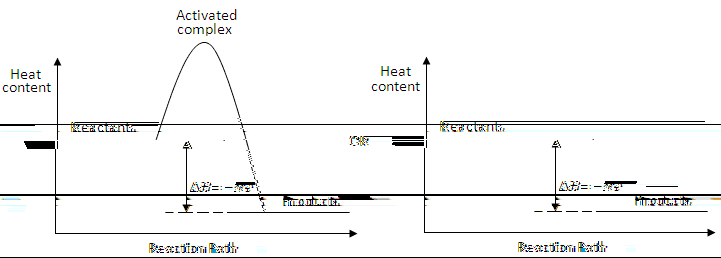
An exothermic reaction is one which gives out heat to the surroundings. The enthalpy change, ΔH, for an exothermic reaction is negative because the products have lower enthalpies than the reactants. Example of an exothermic reaction:
N₂(g) + 3H₂(g) → 2NH₃(g) ΔH = −92 KJmol⁻¹
Endothermic Reactions
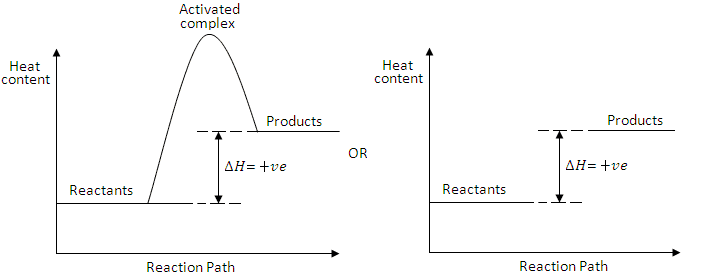
An endothermic reaction is one in which heat energy is absorbed from the surroundings. The enthalpy change, ΔH, for an endothermic reaction is positive because the products have higher enthalpies than the reactants. Example of an endothermic reaction:
N₂(g) + O₂(g) → 2NO(g) ΔH = +180.6 KJmol⁻¹
The Source of Heat Change in Chemical Reactions
The heat change that accompanies a chemical reaction comes from the breaking and making of bonds. Bonds are broken in the reactants and new bonds are made in the products. Heat is absorbed in breaking bonds and is released in making bonds.
Some Heat of Reactions
- Heat of combustion: This is the heat evolved when one mole of a substance is completely burnt in oxygen.
- Heat of neutralization: This is the heat evolved when one mole of hydrogen ions (H⁺) from an acid reacts with one mole of hydroxide ions (OH⁻) from an alkali to form one mole of water.
H⁺(aq) + OH⁻(aq) → H₂O(l) ΔH = heat of neutralisation - Heat of precipitation: This is the heat evolved when one mole of an insoluble salt is precipitated from its ions in aqueous solution.
e.g. Ag⁺(aq) + Cl⁻(aq) → AgCl(s) ΔH = −65.7 KJmol⁻¹ is the heat of precipitation of AgCl. - Heat of solution: This is the heat absorbed or evolved when one mole of a substance is dissolved in so much water that further dilution produces no detectable heat change.
Remark: The heat change for a reaction occurring at standard temperature (25℃ or 298K) and atmospheric pressure (1atm or 10⁵ Pa) is called the standard heat change, denoted by ΔHθ.
Experimental Determination of Heat of Reactions
A. Heat of Combustion of Ethanol
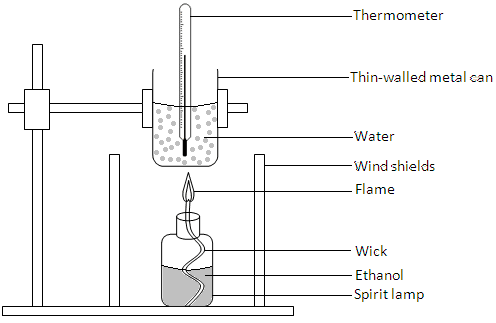
Requirements: Ethanol, thin-walled metal can, thermometer, spirit lamp, water, wind shields, chemical balance and a clamp and stand.
Procedure:
- Set up the apparatus as shown above in a draught-free area.
- A spirit lamp containing ethanol is weighed and the mass (m₁) is recorded.
- Using a chemical balance, a given volume of water, say 100cm³, is measured and placed in a thin-walled metal can clamped above the spirit lamp.
- The initial temperature of the water (θ₁) is measured using a thermometer and recorded.
- The wick of the spirit lamp is lit and the flame is used to heat the water in the metal can while stirring.
- After heating for some time, the final temperature of the water (θ₂) is recorded and the flame is immediately put out.
- The spirit lamp with the remaining ethanol is re-weighed and the mass (m₂) is recorded.
Precautions:
- The flame should be shielded with wind shields to avoid deflection by the wind.
- The water should be constantly stirred during heating to ensure a uniform distribution of heat.
- The spirit lamp should be tightly closed to prevent evaporation of ethanol since it is highly volatile.
Data collection:
- Initial temperature of water = θ₁
- Final temperature of water = θ₂
- Temperature change, Δθ = θ₂ − θ₁
- Mass of lamp + ethanol before burning = m₁
- Mass of lamp + ethanol after burning = m₂
- Mass of ethanol used = m₁ − m₂
Calculations: Assuming all heat produced by burning ethanol is gained by the water, i.e. no heat losses occur:
Heat evolved by burning ethanol = Heat gained by the water in the can = mwCwΔθ joules = (mwCwΔθ)/1000 kilojoules
Where mw = mass of water and Cw = specific heat capacity of water = 4.2 Jg⁻¹K⁻¹.
Number of moles of ethanol used = (m₁ − m₂) / molar mass of ethanol
∴ Heat of combustion of ethanol = −[MM × mwCwΔθ] / [(m₁ − m₂) × 1000] KJmol⁻¹
Worked Example
In one experiment: mass of spirit lamp + content before burning = 66.82g; mass after burning = 66.41g; initial temperature of water = 25.2℃; final temperature of water = 50.0℃; volume of water heated = 100cm³.
Solution:
Mass of water = density × volume = 1gcm⁻³ × 100cm³ = 100g
Heat produced by burning ethanol = MCΔθ = (100g)(4.2Jg⁻¹K⁻¹)(50.0℃ − 25.2℃) = 10416J = 10.416KJ
Mass of ethanol burnt = 66.82g − 66.41g = 0.41g
Molar mass of ethanol (C₂H₅OH) = (12×2) + (1×5) + 16 + 1 = 46g
Number of moles of ethanol burnt = 0.41/46 = 0.0089 mole
If 0.0089 mole of ethanol produces 10.416KJ of heat, 1 mole will produce 10.416/0.0089 = 1170.3 KJmol⁻¹
∴ Heat of combustion of ethanol = −1170.3 KJmol⁻¹
The value obtained is less than the theoretical value due to heat losses to the surroundings and the metal can, and experimental errors.
B. Heat of Neutralisation of Sodium Hydroxide with Hydrochloric Acid
To determine the heat of neutralisation experimentally, equal volumes of an acid and an alkali of equal concentrations are used.
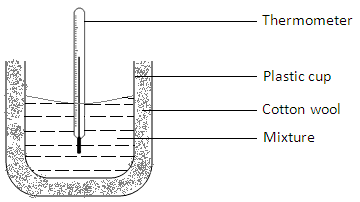
Requirements: a thermometer, a lagged plastic cup, a measuring cylinder, 1M NaOH and 1M HCl.
Procedure:
- Using a measuring cylinder, 100cm³ of 1M HCl is measured and put into a clean, well-lagged plastic cup.
- The temperature of the acid (TA) is taken and recorded.
- The measuring cylinder and thermometer are rinsed with distilled water and then with a little aqueous sodium hydroxide.
- 100cm³ of 1M NaOH is measured and its temperature (TB) is taken and recorded.
- The alkali is quickly transferred into the acid while stirring gently with the thermometer. The final temperature attained by the mixture (T₂) is read and recorded.
Precautions:
- The plastic cup should be well-lagged with cotton wool to minimise heat loss to the surroundings.
- The mixture should be gently stirred with the thermometer to ensure a uniform distribution of heat and to prevent generation of heat by friction.
- After measuring the acid, the measuring cylinder and thermometer should be rinsed with distilled water and then a little of the alkali before measuring the alkali to prevent pre-neutralisation.
Calculations: Initial temperature of the mixture, T₁ = (TA + TB)/2. Final temperature = T₂. Temperature change, Δθ = T₂ − T₁. Volume of mixture = 200cm³, mass of mixture = 200g (assuming density equal to water).
Heat evolved on mixing = MCΔθ joules = (200 × 4.2 × (T₂−T₁))/1000 kilojoules
NaOH(aq) + HCl(aq) → NaCl(aq) + H₂O(l). Number of moles HCl = molarity × volume(dm³) = 1 × 0.1 = 0.1 mole, which produces 0.1 mole of H₂O.
∴ Heat of neutralisation = −8.4(T₂ − T₁) KJmol⁻¹
Worked Example
Volume of 1M HCl = 100cm³; volume of 1M NaOH = 100cm³; initial temperature of acid = 25℃; initial temperature of alkali = 25.2℃; final temperature of mixture = 31.9℃.
Solution:
Mass of mixture = 200cm³ × 1gcm⁻³ = 200g
Initial temperature of mixture = (25 + 25.2)/2 = 25.1℃
Change in temperature, Δθ = 31.9 − 25.1 = 6.8℃
Heat evolved = MCΔθ = 200 × 4.2 × 6.8 = 5712J = 5.712KJ
Number of moles of HCl = 1M × 0.1dm³ = 0.1 mole, producing 0.1 mole of water.
Formation of 0.1 mole water evolves 5.712KJ, so 1 mole evolves 5.712/0.1 = 57.12 KJmol⁻¹
∴ Heat of neutralisation of sodium hydroxide with hydrochloric acid = −57.12 KJmol⁻¹
C. Heat of Precipitation of Silver Chloride
Requirements: a plastic cup, solutions of 1M AgNO₃ and 1M NaCl, a thermometer and a measuring cylinder.
Procedure:
- 25cm³ of 1M AgNO₃ is measured and put into the plastic cup; its initial temperature (T₁) is recorded.
- The measuring cylinder and thermometer are rinsed with distilled water, and 25cm³ of 1M NaCl is measured; its initial temperature (T₂) is recorded.
- The sodium chloride solution is quickly added to the silver nitrate solution and the mixture is stirred gently with the thermometer.
- The highest temperature attained (θ₂) is noted.
Precautions:
- The plastic cup should be well-lagged with cotton wool to minimise heat loss.
- The mixture is stirred gently with the thermometer to ensure an even distribution of heat while avoiding generation of heat by friction.
Calculations: Initial temperature of mixture, θ₁ = (T₁+T₂)/2. Volume of mixture = 50cm³, mass of solution = 50g.
AgNO₃(aq) + NaCl(aq) → AgCl(s) + NaNO₃(aq). Number of moles of AgNO₃ = 1M × 0.025dm³ = 0.025 mole, producing 0.025 mole of AgCl.
∴ Heat of precipitation of silver chloride = −8.4(θ₂ − θ₁) KJmol⁻¹
Worked Example
50cm³ of molar AgNO₃ reacted with 50cm³ of molar NaCl, both initially at 25℃; the final temperature attained on mixing was 29℃.
Solution:
Initial temperature of mixture = (25+25)/2 = 25℃. Final temperature = 29℃. Change in temperature, Δθ = 29 − 25 = 4℃.
Mass of solution = 100cm³ × 1gcm⁻³ = 100g
Heat change = MCΔθ = 100 × 4.2 × 4 = 1680J = 1.68KJ
Number of moles of AgNO₃ = 1M × 0.05dm³ = 0.05 mole, producing 0.05 mole of AgCl.
Formation of 0.05 mole evolves 1.68KJ, so 1 mole evolves 1.68/0.05 = 33.6 KJmol⁻¹
∴ Heat of precipitation of silver chloride = −33.6 KJmol⁻¹
D. Heat of Solution of Anhydrous Copper(II) Sulphate
Requirements: anhydrous copper(II) sulphate, distilled water, measuring cylinder, thermometer, chemical balance, plastic cup and cotton wool.
Procedure:
- 100cm³ of distilled water is measured and poured into a clean, dry, well-lagged plastic cup.
- The initial temperature (θ₁) of the water is measured and recorded.
- Some anhydrous copper(II) sulphate is finely powdered, weighed and the mass (m) is recorded.
- The copper(II) sulphate is immediately added to the water and stirred vigorously with the thermometer until it all dissolves.
- The final temperature (θ₂) attained by the mixture is measured and recorded.
Precautions:
- The plastic cup should be well-lagged to reduce heat loss.
- The solution should be stirred for complete dissolution and to ensure uniform heat distribution.
- The anhydrous copper(II) sulphate should be finely powdered so that it dissolves faster.
Calculations: Change in temperature, Δθ = θ₂ − θ₁. Mass of solution = 100g. Molar mass of CuSO₄ = 64 + 32 + (4×16) = 160g.
Heat change = MCΔθ = 100 × 4.2 × (θ₂−θ₁) = 0.42(θ₂−θ₁) kilojoules
Number of moles of CuSO₄ = m/160 moles.
∴ Heat of solution of CuSO₄ = −[67.2(θ₂−θ₁)]/m KJmol⁻¹
Worked Example
16g of anhydrous copper(II) sulphate was used to prepare 100cm³ of solution and a temperature change of 1.4℃ was recorded.
Solution:
Heat change = MCΔθ = 100 × 4.2 × 1.4 = 588J = 0.588KJ
Number of moles of CuSO₄ = 16/160 = 0.1 mole
1 mole of CuSO₄ evolves 0.588/0.1 = 58.8 KJmol⁻¹
∴ Heat of solution of CuSO₄ = −58.8 KJmol⁻¹