Introduction
Group IV, also called Group 14, contains carbon, silicon, germanium, tin and lead. The elements have the general outer electronic configuration ns²np² and commonly show the +2 and +4 oxidation states.
Why carbon is unique
Carbon exhibits extensive catenation, the ability to form strong covalent chains and rings. Its small atomic radius allows strong C–C bonds, and it forms sp, sp² and sp³ hybrid orbitals. Diamond and graphite are important giant covalent allotropes.
Allotropy and structure
Allotropy is the existence of an element in more than one structural form in the same physical state. Carbon, silicon and germanium have giant covalent structures, whereas tin and lead have giant metallic structures.
Periodic trends
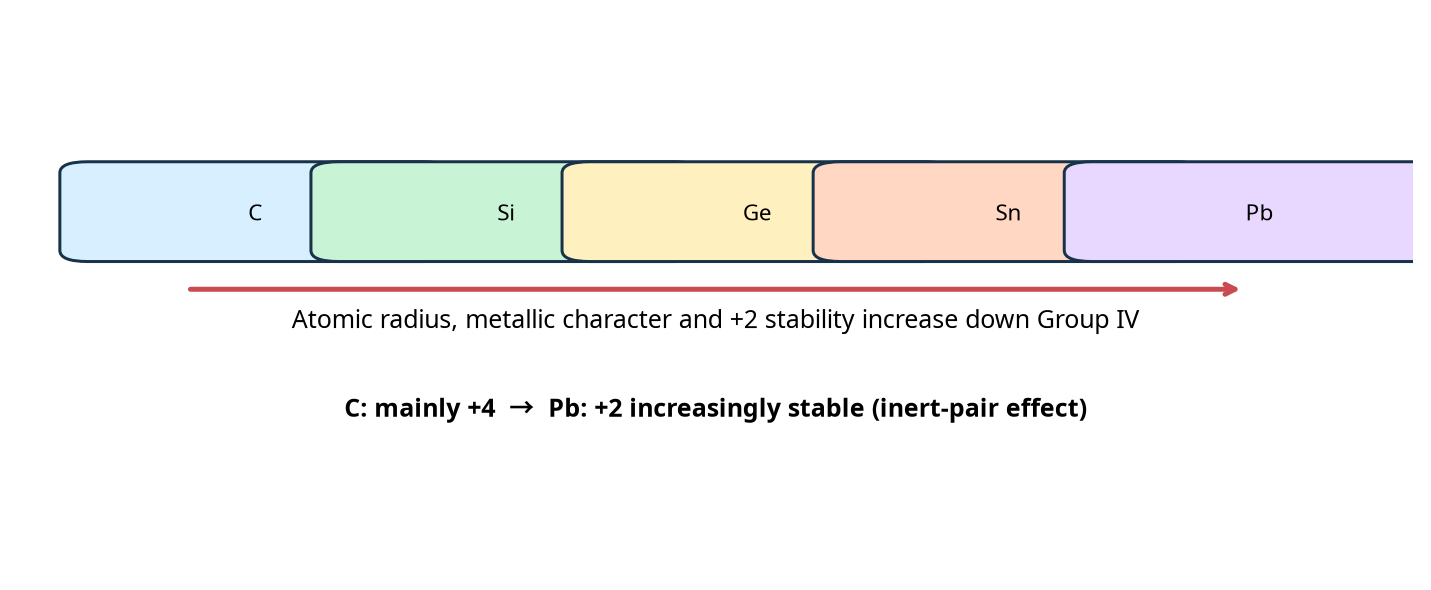
Atomic radius increases down the group because additional electron shells and shielding are introduced. First ionisation energy and electronegativity generally decrease. Melting points fall from carbon to germanium and change sharply as metallic structures become more important.
Chemical properties
Members form oxides on heating in oxygen. Carbon forms CO₂, silicon forms SiO₂ and lead commonly forms PbO. Silicon reacts with hot concentrated alkali to form silicate and hydrogen.
Oxidation states and inert-pair effect
The stability of the +4 state decreases down the group while +2 becomes more stable. The inert-pair effect describes the increasing reluctance of the outer s-electron pair to participate in bonding in heavier elements.
Key examination points
- Explain catenation and allotropy.
- Describe the inert-pair effect.
- Relate oxide character to position down the group.
- Explain the change from covalent to metallic structures.