Bonding in Carbon Atoms
Each carbon atom has four valence electrons and hence can form a maximum of four covalent bonds with other atoms in order to attain the stable octet structure.
Homologous Series
The numerous organic compounds, for convenient study, are grouped into families such that members of any one family have certain characteristics in common. Each of these families is called a homologous series and its members are called homologues.
Definition: A homologous series is a family of organic compounds with similar chemical properties and in which each successive member differs in its molecular formula by an additional –CH₂– group.
Characteristics of a Homologous Series
The members of a homologous series have:
- The same general formula.
- The same general method of preparation.
- Gradually increasing melting and boiling points as the molecular masses of the members increase.
- Similar chemical properties because they have the same functional group.
Functional Groups
A functional group is an atom or a group of atoms or a type of bond that is present in a compound and is responsible for its chemical properties.
The table below contains the functional groups and the general formulas of some homologous series.
| Homologous Series | Functional Group | General Formula |
|---|---|---|
| Alkanes | C–C single bonds | CnH2n+2, n ≥ 1 |
| Alkenes | C=C double bond | CnH2n, n ≥ 2 |
| Alkynes | C≡C triple bond | CnH2n−2, n ≥ 2 |
| Alcohols or alkanols | –OH (hydroxyl group) | CnH2n+1OH, n ≥ 1 |
| Carboxylic acids or organic acids | –COOH (carboxyl group) | CnH2n+1COOH, n ≥ 1 |
| Haloalkanes | Halogen atom (X) | R–X, where R is an alkyl group |
| Esters | –COO– (ester group) | R–COO–R′ |
| Ethers | –O– (ether group) | R–O–R′ |
Alkyl Groups
An alkyl group is a group derived from an alkane by the loss of an atom of hydrogen. Examples of alkyl groups are:
| Alkyl Group | Formula |
|---|---|
| Methyl | –CH₃ |
| Ethyl | –CH₂CH₃ or –C₂H₅ |
| Propyl | –CH₂CH₂CH₃ or –C₃H₇ |
Saturated and Unsaturated Compounds
- Saturated compounds: A saturated organic compound is one having only carbon to carbon single bonds in its molecular structure, e.g. alkanes are saturated compounds.
- Unsaturated compounds: An unsaturated organic compound is one which has at least one carbon to carbon double bond or carbon to carbon triple bond in its molecular structure, e.g. alkenes and alkynes are unsaturated compounds.
The Nomenclature of Organic Compounds
Organic compounds are named according to the IUPAC system of nomenclature. The IUPAC name of an organic compound consists of three main parts:
PREFIX + ROOT + SUFFIX
Root: The root tells the number of carbon atoms in the longest continuous carbon chain in the molecule. The roots for the ten smallest alkanes are shown in the table below.
| Root | Number of Carbon Atoms |
|---|---|
| Meth- | 1 |
| Eth- | 2 |
| Prop- | 3 |
| But- | 4 |
| Pent- | 5 |
| Hex- | 6 |
| Hept- | 7 |
| Oct- | 8 |
| Non- | 9 |
| Dec- | 10 |
Suffix: The suffix tells the type of organic compound the molecule represents, i.e. it identifies the principal functional group the molecule possesses. The suffix is placed after the root; hence the name of an organic compound ends with the suffix. Compounds belonging to the same homologous series have the same suffix. Examples of suffixes are given in the table below.
| Homologous Series | Suffix |
|---|---|
| Alkanes | –ane |
| Alkenes | –ene |
| Alkynes | –yne |
| Alcohols or alkanols | –ol |
| Carboxylic acids | –oic |
| Esters | –oate |
Prefix: Each prefix identifies a group (alkyl groups or other functional groups apart from the principal functional group) attached to the main chain and the number of the carbon to which it is attached. Each prefix is placed before the root, i.e. it begins the name of an organic compound. Examples of prefixes are given in the table below.
| Name | Prefix |
|---|---|
| Methyl- | –CH₃ |
| Chloro- | –Cl |
| Bromo- | –Br |
| Iodo- | –I |
| Amino- | –NH₂ |
IUPAC Rules for Naming Organic Compounds
- Select the longest hydrocarbon chain to give the root of the name.
- Name the suffix. The suffix must correspond to the principal functional group present in the compound.
- Number the carbon atoms of the longest hydrocarbon chain such that the carbon atom bearing the suffix takes the lowest possible number. In the case of alkanes, numbering is such that any carbon atom bearing a prefix takes the lowest possible number.
- Name the prefix or prefixes (if the compound has no prefixes, the name consists of the root and suffix only). When two or more prefixes are present, their names appear in alphabetical order.
- Attach a number to each prefix to indicate its position on the longest hydrocarbon chain. Where necessary, attach a number to the suffix to indicate its position.
- Indicate identical prefixes and suffixes using: di, tri, tetra, penta, etc, which represent 2, 3, 4, 5, etc respectively.
- In the name, two numbers are separated by a comma (,) while a number and a word are separated by a hyphen (-).
Examples
Give the IUPAC or systematic names of the following organic compounds:



Remark: In addition to these systematic names, some important common names are still in use. Examples include:
| Compound | Systematic Name | Common Name |
|---|---|---|
| C₂H₄ | Ethene | Ethylene |
| C₂H₂ | Ethyne | Acetylene |
| CH₃COOH | Ethanoic acid | Acetic acid |
| CHCl₃ | Trichloromethane | Chloroform |
Hydrocarbons
A hydrocarbon is a compound that contains only carbon and hydrogen.
All alkanes, alkenes and alkynes are hydrocarbons. Alkanes are the only saturated hydrocarbons, while alkenes and alkynes are unsaturated. Hydrocarbons are of two main types, namely aliphatic and aromatic hydrocarbons.
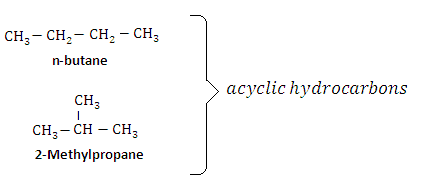
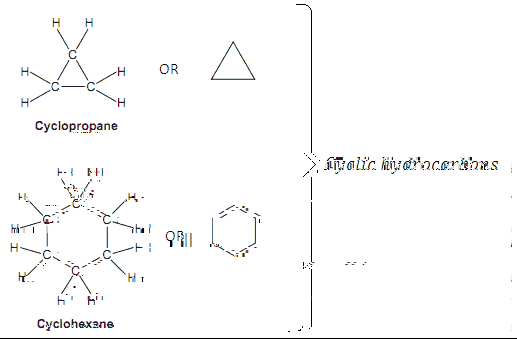
- Aliphatic hydrocarbons: These may be straight, branched or ring compounds. Those that are straight or branched are called acyclic hydrocarbons, while those that are in the form of rings are called alicyclic hydrocarbons. Examples of acyclic and cyclic hydrocarbons are given below.
- Aromatic hydrocarbons: These are hydrocarbons that contain one or more benzene rings. Examples are:
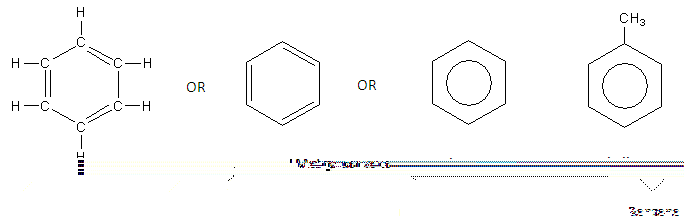
Empirical, Molecular and Structural Formulae of Organic Compounds
- Empirical formula: It is the simplest formula of a compound which gives the simplest whole number ratio of the different atoms present in the compound.
- Molecular formula: It is the formula of a compound which shows the actual number of each kind of atom present in one molecule of the compound.
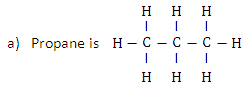
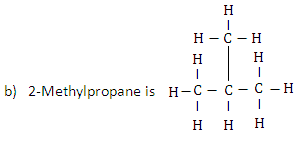
- Structural formula: It shows the arrangement of atoms of elements in one molecule of a compound, e.g. the structural formula of propane and 2-methylpropane:
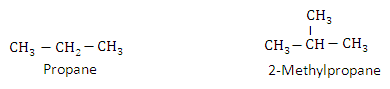
Remark: The structural formula of an organic compound can also be written in the condensed form. The structural formulae of propane and 2-methylpropane, in the condensed form, are as follows:
Solved Examples
- A hydrocarbon containing 86% of carbon and 14% of hydrogen has a molecular mass of 70. Determine its:
- Empirical formula.
- Molecular formula.
- On complete combustion in oxygen, 0.42 g of a gaseous hydrocarbon (X) gave 1.32 g of carbon dioxide and 0.54 g of water.
- What is the empirical formula of X?
- 0.21 g of X occupied a volume of 120 cm³ at r.t.p, what is the relative molecular mass of X?
- Hence, determine the molecular formula of X.
Isomerism
It is the existence of two or more organic compounds having the same molecular formula but different molecular structures.
Isomers
These are organic compounds that have the same molecular formula but different molecular structures.
Isomers may belong to the same or different homologous series. Those in the same homologous series undergo similar chemical reactions (because they have the same functional group) but have different physical properties. Those in different homologous series differ in both chemical and physical properties.
Types of Isomerism
There are two main types of isomerism, namely structural isomerism and stereoisomerism.
Structural Isomerism
Two types of structural isomerism exist, which are:
- Chain isomerism: Chain isomers have the same molecular formula but different molecular structures and belong to the same homologous series, i.e. they have the same functional group.
Example: Write the names and molecular structures of all the isomers having the following molecular formulas:
- C₅H₁₂
- C₅H₁₀
- Functional group isomerism: Functional group isomers have the same molecular formula but different functional groups and different molecular structures. They belong to different homologous series.
Example: Write the names and molecular structures of all the isomers having the molecular formula: C₂H₆O
Petroleum
Petroleum is a naturally occurring black viscous oil that consists chiefly of hydrocarbons. In its un-refined form, petroleum is known as crude oil. Petroleum usually occurs together with natural gas, and both are derived from the products of the decay of dead organisms under high pressures.
Crude oil is usually refined at the oil refinery (e.g. SONARA in Limbe), i.e. it is purified and then separated by fractional distillation into groups of hydrocarbons called petroleum fractions.
The Fractional Distillation of Petroleum
After extraction, crude oil is first separated from sand and water. The petroleum obtained is pre-heated to about 400℃ in an electric furnace. The vapour obtained is pumped into a fractionating tower at the base. As the vapour rises up the tower, its temperature drops, and the various fractions cool and condense and are collected separately.
Uses of the Various Petroleum Fractions
| Petroleum Fraction | Approximate Number of Carbon Atoms | Uses |
|---|---|---|
| Petroleum gas (refinery gas) | C₁–C₄ | Fuel at home (cooking gas); fuel in laboratories and industries. |
| Petrol or gasoline | C₅–C₁₀ | Fuel in cars, motor bikes etc.; solvent for paint, grease, etc. |
| Kerosene or paraffin oil | C₁₁–C₁₅ | Fuel for domestic lighting and heating; fuel in jet engines; usually cracked to petrol. |
| Diesel or gas oil | C₁₅–C₁₆ | Fuel in diesel engines and other automobiles; raw material for cracking. |
| Lubricating oil and paraffin waxes | C₂₀–C₄₀ | Lubricating oil is used as lubricant for the moving parts of machines and to manufacture petroleum jelly (Vaseline); paraffin wax is used to make candles. |
| Bitumen | Above C₄₀ | Used for road surfacing. |
Cracking
It is the process of breaking down long chain hydrocarbons into simpler, shorter chain hydrocarbons.
There are two types of cracking, namely thermal and catalytic cracking.
- Thermal cracking: It occurs at very high temperatures of about 700℃ in the absence of a catalyst.
- Catalytic cracking: It occurs at relatively lower temperatures of about 500℃ in the presence of a catalyst such as silica (SiO₂) and alumina (Al₂O₃).
Examples
When decane is heated in the presence of a catalyst (made up of silica, alumina and zeolites) to about 500℃, it is cracked into octane and ethene.
C₁₀H₂₂(decane) →500℃, catalyst C₈H₁₈(octane) + C₂H₄(ethene)
Under similar conditions, undecane undergoes cracking as follows:
C₁₁H₂₄(undecane) →500℃, catalyst C₉H₂₀(nonane) + C₂H₄(ethene)
Economic Importance of Cracking
- It is used in petrochemical industries to provide extra petrol and to convert low grade petrol to high grade petrol that will cause less air pollution.
- It is a source of alkenes, which are raw materials for the manufacture of plastics and detergents and for the preparation of organic compounds such as ethanol, etc.