The Kinetic Theory of Matter
The kinetic theory of matter states that matter is made up of tiny particles (molecules, atoms) which are in continuous motion.
States of Matter
Matter exists in three states, that is:
- Solid
- Liquid
- Gas
Change of State
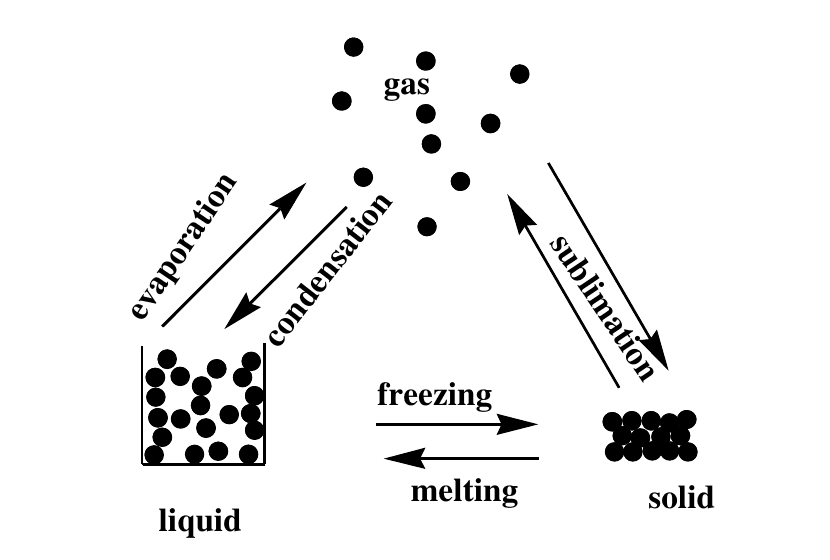
A given substance can exist in the three states of matter. Change of state is brought about by a change of temperature.
Melting
When a solid is heated, the particles gain more kinetic energy (heat) and vibrate more violently. In the end, it will reach a temperature called the melting point of the solid. The force of vibration overcomes the binding forces and the solid structure collapses (breaks down) into liquid.
Evaporation
Generally, evaporation occurs at all temperatures, but the rate of evaporation increases with an increase in temperature. This is because the average kinetic energy of the liquid is greater at a higher temperature, so there are more particles with sufficient energy to vaporize.
Gas Laws
Boyle’s Law
Boyle’s Law states that the volume (V) of a given mass of gas is inversely proportional to its pressure (P), provided the temperature remains the same.
That is, V ∝ 1/P ⇒ V = K/P
or PV = K
The relationship can also be expressed mathematically as:
P₁V₁ = P₂V₂
Note that if the pressure of the gas increases, its volume decreases, and vice versa.
Exercise: If 65 cm³ of an ideal gas exerts a pressure of 375 mmHg at 10°C, find the pressure that the same gas will exert if its volume increases to 75 cm³ at the same temperature.
Charles’ Law
Charles’ Law states that the volume of a given mass of gas is directly proportional to its temperature, provided the pressure remains constant.
V ∝ T ∴ V = KT or K = V/T
or V₁/T₁ = V₂/T₂
Note that if the temperature increases, the volume also increases.