Polymerisation
Polymerisation is a reaction in which many simple molecules called monomers link together to form a larger and complex molecule called a polymer.
Monomers: These are simple molecules which can join together to form a larger complex molecule called a polymer.
Polymer: A polymer is a complex molecule formed when monomers link together.
Types of Polymerisation
There are two main types of polymerisation, namely addition and condensation polymerisation.
1. Addition Polymerisation
It is a process in which unsaturated monomers of the same kind join together by undergoing addition reactions to form a polymer, without any loss of materials.
All addition polymers are formed from one type of monomer and hence they are homopolymers.
Examples of Addition Polymers
a) Polyethene: The monomer is ethene, CH₂=CH₂.
When ethene molecules are heated to a temperature of about 200℃ under a pressure of about 1500atm, in the presence of a trace of oxygen as a catalyst (or in the presence of a Ziegler catalyst), the monomers join together to form polyethene. The polyethene formed under these conditions is called low density polythene (LDPE).
2n CH₂=CH₂(ethene molecules) →trace O₂ or Ziegler catalyst, 200℃, 1500atm –[CH₂–CH₂]n–(polyethene, LDPE)
High density polyethene (HDPE) is formed when the ethene monomers are heated to a lower temperature of about 67℃ under a lower pressure of about 30atm, in the presence of a special catalyst of triethylaluminium [Al(C₂H₅)₃] and titanium(IV) chloride (TiCl₄).
Properties of polyethene: Polythene is tough and flexible, highly resistant to chemical attack, and a poor conductor of electricity and heat.
Uses of polyethene: making polyethene bags, pipes, crates, dustbins, toys, buckets, etc.; making electrical insulators.
b) Polystyrene (polyphenylethene): Its monomer is styrene (phenylethene), CH₂=CHC₆H₅.
When styrene molecules are stirred in a peroxide catalyst (benzoyl peroxide) and heated to a temperature of about 150℃ under a high pressure, the molecules link together to form polystyrene.
2n CH₂=CHC₆H₅(styrene molecules) →benzoyl peroxide, 150℃, high pressure polystyrene
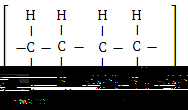
Properties of polystyrene: Polystyrene is light, hard and brittle; transparent; and a poor conductor of electricity and heat.
Uses of polystyrene: making packaging materials; moulded into battery cases; making switches and brush handles; refrigerator parts.
c) Polyvinylchloride (PVC): The monomer of PVC is vinylchloride (chloroethene), CH₂=CHCl.
Vinylchloride molecules, when heated to a temperature of about 60℃ under high pressure in the presence of a peroxide catalyst (hydrogen peroxide), link together to form polyvinylchloride.
2n CH₂=CHCl(vinylchloride molecules) →hydrogen peroxide, 60℃, high pressure –[CH₂–CHCl]n–(polyvinylchloride, PVC)
Properties of polyvinylchloride: PVC is strong and hard (not as flexible as polyethene).
Uses of polyvinylchloride: making water pipes; false or imitation leather; plastic roofing sheets; raincoats and floor coverings; reagent bottles in laboratories; cases of electrical appliances.
d) Perspex (polymethylmethacrylate): Its monomer is methylmethacrylate (methyl 2-methylpropenoate), CH₂=C(CH₃)COOCH₃.
When methylmethacrylate molecules are heated to a temperature within the range 70℃ to 80℃ under high pressure, in the presence of a peroxide catalyst (benzoyl peroxide or hydrogen peroxide), they join together to form Perspex.
2n CH₂=C(CH₃)COOCH₃(methylmethacrylate molecules) →benzoyl peroxide or hydrogen peroxide, 70℃–80℃, high pressure Perspex
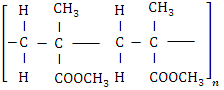
Properties of Perspex: Perspex is colourless and transparent; hard and glass-like.
Uses of Perspex: as a substitute for glass; in the manufacture of window-panes and windscreens; in making lenses, prisms, dentures and artificial teeth; in making car rear lights and street light fittings; in the manufacture of laboratory equipment; in making aircraft windows.
2. Condensation Polymerisation
It is a process in which monomers, usually saturated molecules, combine by undergoing condensation reactions to form a polymer, with elimination of small molecules (e.g. H₂O, NH₃).
Most condensation polymers are formed from two different monomers and are therefore copolymers.
Examples of Condensation Polymers
a) Nylon: Several types of nylon with slightly different properties can be formed from the condensation polymerisation of difunctional monomers, which are diamines and dicarboxylic acids. The commonest type of nylon is nylon 6,6, so called because its two monomers each contain six carbon atoms.
Preparation of nylon 6,6: The monomers of nylon 6,6 are difunctional (i.e. they have two functional groups). These are hexane-1,6-diamine, H₂N–(CH₂)₆–NH₂, and hexane-1,6-dioic acid (adipic acid), HOOC–(CH₂)₄–COOH.
To prepare nylon 6,6, an aqueous solution of hexane-1,6-diamine is added to a solution of hexane-1,6-dioic acid in tetrachloromethane as a solvent. The mixture is heated in the presence of ammonia as a catalyst, and after cooling, nylon 6,6 is formed.
n H₂N–(CH₂)₆–NH₂(hexane-1,6-diamine) + n HOOC–(CH₂)₄–COOH(hexane-1,6-dioic acid) →ammonia, heat –[NH–(CH₂)₆–NH–CO–(CH₂)₄–CO]n–(nylon 6,6) + 2n H₂O
The group –NH–CO– in nylon is called the amide linkage or the peptide linkage.
Uses of nylon 6,6: Nylon 6,6 is a synthetic fibre that is used in the manufacture of carpets, fabrics, ropes, stockings, fishing nets and racquet strings. It is also moulded into machine parts like gears and bearings.
b) Polyesters: They are formed from the condensation polymerisation of difunctional compounds, which are dihydric alcohols and dicarboxylic acids.
Terylene (Dacron) is a typical example of a polyester, prepared from the monomers benzene-1,4-dicarboxylic acid (terephthalic acid), HOOC–C₆H₄–COOH, and ethane-1,2-diol, HO–C₂H₄–OH.
n HOOC–C₆H₄–COOH(terephthalic acid) + n HO–C₂H₄–OH(ethane-1,2-diol) →heat –[CO–C₆H₄–CO–O–C₂H₄–O]n–(terylene/Dacron) + 2n H₂O
Uses of terylene: Terylene is used in making clothes, fishing nets, ropes and the sails of boats. It is usually used in place of wool.
Differences Between Addition and Condensation Polymerisation
| Addition Polymerisation | Condensation Polymerisation |
|---|---|
| Monomers are unsaturated molecules. | Monomers are saturated molecules. |
| No loss of materials occurs in the process. | The loss of small molecules occurs. |
| Monomers are always of the same kind. | Monomers are often of different kinds. |
Natural and Synthetic Polymers
- Natural polymers: They are made naturally in living organisms. Examples of natural polymers are starch, cellulose, proteins, etc.
Starch: It is a carbohydrate made by the condensation polymerisation of glucose molecules. It consists of the elements carbon, hydrogen and oxygen.
n C₆H₁₂O₆(glucose molecules, monomers) → (C₆H₁₀O₅)n(starch, polymer) + n H₂O
Proteins: They are natural polymers formed by the condensation polymerisation of amino acid molecules. They consist of the elements carbon, hydrogen, oxygen, nitrogen and sulphur. The general formula of an amino acid is H₂N–CHR–COOH, where R is an alkyl group. Amino acid monomers join together through amide linkages (–NH–CO–), with the elimination of water, to form proteins.
- Synthetic polymers: Artificial or synthetic polymers are called plastics. Examples include polyethene, polystyrene, PVC, Perspex, nylon, terylene, etc.
Advantages of Plastics
- They are durable and resistant to chemical attack.
- They are lighter than steel, wood, etc.
- They are electrical and thermal insulators.
Disadvantages of Plastics
- They are non-biodegradable, i.e. they are not decomposed by micro-organisms, and waste plastics constitute a serious environmental problem.
- Toxic fumes are produced when many plastics are burnt, thus causing atmospheric pollution. This can be controlled by burning plastics in incinerators.